
Snoring and sleep apnoea
Anti-snoring splint in Küsnacht: snoring and sleep apnoea explained
Zahnklinik Küsnacht offers an anti-snoring splint. The clinic is in Goldbach, right by the station. The splint holds your lower jaw slightly forward while you sleep, so your throat stays more open. This can reduce snoring in many people. How much it helps differs from person to person. Before a splint is made, a sleep study is advisable. It shows whether you have sleep apnoea. We check during your examination whether a splint is right for you. Online, you can request a consultation about the snoring splint.
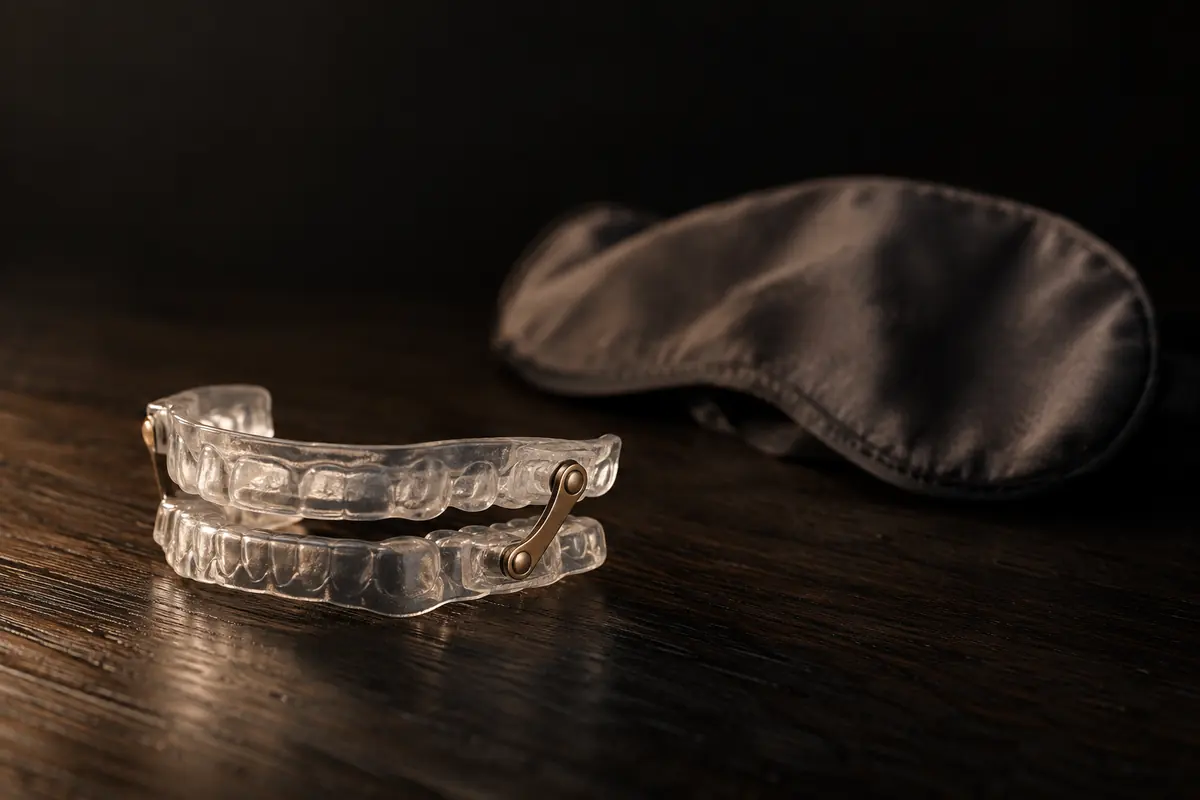
How an anti-snoring splint works
How a mandibular advancement splint is built
Specialists call the anti-snoring mouth splint a mandibular advancement splint. It has two parts, one for the upper jaw and one for the lower jaw. Connectors join them and hold the lower jaw slightly forward. This forward position can be adjusted in small steps. A splint from the dentist is made from an impression or scan of your own teeth.
Why the airway narrows when you sleep
During sleep, the muscles and soft tissue in the throat relax, and the tongue sinks back. As air flows through this narrow point, the tissue vibrates. You hear this as snoring. The splint brings the lower jaw forward, and the tongue with it. This keeps the throat more open.
Snoring splint, aligner or night guard
Clear aligners for straightening teeth move teeth step by step into a new position. A night guard for teeth grinding protects the teeth from wear at night. A snoring splint is not meant to move any teeth. It only holds the lower jaw forward while you sleep.
Why a sleep study comes before the splint
Snoring alone is usually harmless but can point to sleep apnoea. Whether you have it determines which treatment is right and whether insurance pays.
Simple snoring or obstructive sleep apnoea
With simple snoring, breathing continues despite the narrowing. In obstructive sleep apnoea, the airway keeps closing partly or completely during sleep. According to Lungenliga, the Swiss lung association, this can happen as many as several hundred times a night. Those affected usually do not notice it but feel the effects during the day. If sleep apnoea goes untreated for a long time, the risk of high blood pressure, heart attack and stroke rises. It can be treated effectively, however.
Signs to have checked by a doctor
Talk to your GP (family doctor) if you or the people around you notice any of these:
- witnessed pauses in breathing during sleep
- loud, irregular snoring
- severe daytime tiredness or falling asleep unintentionally
- headaches in the morning
- difficulty concentrating
- in women, more typically trouble staying asleep and mood swings
How sleep apnoea is diagnosed in Switzerland
Your GP practice is usually the first point of contact. It arranges a sleep test (the measurement in a sleep study) or refers you to a sleep medicine specialist. The test takes place at home with a portable device or in a sleep laboratory. A doctor makes the diagnosis.
When a sleep apnoea splint is an option
Whether a splint is an option for sleep apnoea depends on the test results and on your teeth.
Splint or CPAP
For moderate to severe sleep apnoea, lung specialists usually prescribe CPAP (continuous positive airway pressure) therapy. A device keeps the airways open at night with air pressure delivered through a mask. The splint is mainly an option for mild to moderate sleep apnoea, or if someone cannot tolerate the mask. Your doctor decides which treatment is right.
What your teeth, gums and jaw joint need
The splint needs a firm hold on enough healthy teeth. Loose teeth or advanced periodontitis (gum disease) count against it. If one jaw has no teeth, it needs a full set of replacement teeth that sit securely. Your lower jaw must also move far enough forward, and the jaw joint is assessed. A check-up of your teeth and gums shows whether this applies to you.
Limits and possible side effects
The splint only works while you wear it and does not cure sleep apnoea. In the first one to two weeks, you may feel a dull ache or sensitivity in your teeth. Tense jaw muscles and increased or reduced saliva can also occur. This usually settles as you get used to the splint. Long-term wear can change your bite and tooth position, so regular check-ups are needed. With sleep apnoea, a test while you wear the splint shows whether it is sufficient.
How the splint is usually made and fitted
This is how a snoring splint is usually made. At your consultation, we discuss how many appointments it takes at our clinic.
Examination and impression or scan
First, the teeth, gums and jaw joint are examined. Then an impression or a scan records both jaws. A separate page explains how a digital dental impression with a 3D scan is taken.
Made to measure
A dental laboratory makes the splint from the impression or scan. The starting position of the lower jaw, meaning how far forward it sits, is also set.
Fitting, adjusting and check-ups
The fit is checked when the splint is first put in. The forward position is then usually increased in steps until the splint has the intended effect and feels comfortable. Later, the fit, teeth and bite are checked.
Anti-snoring splint cost and health insurance in Switzerland
Basic health insurance when sleep apnoea is diagnosed
Swiss basic health insurance (Grundversicherung) does not usually cover dental treatment. An exception is set out in Article 19 letter e of the KLV, the Swiss ordinance on health insurance benefits. Since 1 July 2014, basic insurance has paid for dental treatment needed to support the medical treatment of sleep apnoea syndrome.
According to Lungenliga, the insurer then covers the splint in most cases. This requires a prescription from a lung or ENT (ear, nose and throat) specialist. Cover is requested from the insurer in advance, and a new splint is paid for at most once every three years. The deductible (Franchise) and co-payment (Selbstbehalt) apply as usual.
For simple snoring, you usually pay yourself
Without a sleep apnoea diagnosis or a specialist's prescription, you usually pay for the splint yourself. Whether supplementary insurance (Zusatzversicherung) contributes depends on your policy.
What the price depends on
We bill transparently under the Dentotar tariff, with our tax point value (Taxpunktwert) of CHF 1.13, and give you open advice on costs. The amount depends on the examination, impression or scan, splint system and check-ups. As a guide, Lungenliga quotes CHF 1,200 to 2,000 for high-comfort splints, including examination and advice (as of 2026). These are not prices charged by Zahnklinik Küsnacht.
Anti-snoring splint consultation in Küsnacht
What to bring to your first appointment
It helps to bring the following, if you have them:
- the report from your sleep study
- your doctor's prescription for the splint
- your health insurance card
Requesting an appointment online or by phone
You can request an appointment for the anti-snoring splint in the appointment form. Under “Treatment you are asking about”, choose “Anti-snoring splint”. You can also get advice by phone on +41 44 915 17 77. Our phone line is not staffed during all opening hours. We are also happy to arrange appointments outside opening hours.
The clinic by Küsnacht Goldbach station
The clinic is at Goldbacherstrasse 3a in Küsnacht-Goldbach. There is parking, and the clinic is accessible by wheelchair and rollator. Separate pages show our location by Küsnacht Goldbach station and directions by S-Bahn or car.

Common questions about the anti-snoring splint
Is your question not listed? Call us or send us an email.
+41 44 915 17 77Does an anti-snoring splint work?
It can reduce snoring. How well it works for you cannot be predicted with certainty.
Does health insurance pay for an anti-snoring splint in Switzerland?
With diagnosed sleep apnoea and a specialist's prescription, basic health insurance pays in most cases, minus the deductible and co-payment. For simple snoring, you usually pay yourself.
How much does an anti-snoring splint cost?
It depends on the findings, splint system and check-ups. Billing is under the Dentotar tariff, with our tax point value of CHF 1.13. We discuss the costs openly with you.
Do I need a sleep study before getting an anti-snoring splint?
It is advisable, yes. Only a sleep test shows whether you also have sleep apnoea. The result affects your treatment and your insurance cover.
Snoring mouthguard from the pharmacy or a splint from the dentist?
Ready-made pharmacy splints are usually shaped by the wearer in hot water (boil-and-bite). They are cheaper but fit less precisely. In a comparative study of people with mild sleep apnoea, a custom-made splint reduced snoring more than a ready-made one.
Does an anti-snoring splint help sleep apnoea?
A splint can help, but it is not a full substitute for CPAP. According to Lungenliga, CPAP therapy is more effective, but a splint is better than no treatment. Your doctor makes the decision.
Can I wear an anti-snoring splint with implants or crowns?
Stable crowns and bridges do not rule out a splint in principle. If a jaw has no teeth, an implant-supported denture can provide the hold. Read more about treatment with dental implants. We check during your examination whether this is right for you.
Related pages
- Straightening crooked teeth with aligners
If crooked teeth are your concern.
- Dental check-ups and prevention
Checking teeth and gums before a splint is made.
- Digital 3D scan of the teeth
Recording your teeth in 3D without impression material.
Your appointment for the anti-snoring splint
Online or by phone: we work out with you whether a splint is an option.