
If the dentist makes you anxious
Dentist for anxious patients: dental phobia and your first appointment
People looking for a dentist for anxious patients have often worried about the appointment for a long time. Zahnklinik Küsnacht is in Goldbach, right by the station. This page explains how dental anxiety differs from dental phobia and how your first appointment works. It also covers what a medical certificate does and when your health insurer pays.
You can also ask us in writing. In the form, a short sentence about your anxiety is enough.
The difference between dental anxiety and dental phobia
Fear of the dentist is common. Many nervous patients sleep badly before an appointment and still come. This dental anxiety is unpleasant, but it does not keep them away.
Signs of dental phobia
Fear that keeps someone away from the dentist for years is called dental phobia. The ICD-10 classification lists it as a specific phobia and names dental visits explicitly. Typical signs are a racing heart, sweating or nausea at the mere thought of the appointment. Whether high anxiety amounts to a phobia is for a doctor or psychotherapist to assess.
This often creates a cycle. Avoiding the dentist leaves tooth decay untreated for a long time. Treatment then becomes more extensive, which confirms the fear.
Where dental anxiety often comes from
Often there is a painful experience behind it, sometimes from childhood. Others feel helpless lying back in the chair. Sounds, smells or other people's stories can also feed the fear. If you mainly fear root canal treatment, read in advance how a root canal works today.
Embarrassed about the state of your teeth
After years without a check-up, shame often adds to the fear. With us, you do not have to justify how long you have stayed away or the state of your teeth. Our motto is “Ehrlichkeit, Respekt und Treue” (honesty, respect and loyalty).
Ways to make treatment less stressful
What makes treatment easier differs from person to person. We discuss which options suit you.
If the drill is what worries you most
In many cases, the laser replaces the drill when removing tooth decay. Treatment is then usually barely noticeable, often without anaesthesia. For local anaesthesia, we also use intraosseous anaesthesia: the anaesthetic goes directly into the bone next to the tooth, so your lip and cheek usually do not go numb. Read what the dental laser does differently and in which cases you may not need an injection.
If you gag easily or worry about X-rays
Our digital scanner records your teeth in 3D, without impression material. People who gag easily often find this more comfortable than an impression tray. See how a digital dental impression works. We only take X-rays when needed. They are digital and use around 80 per cent less radiation than conventional methods.
If waiting with other patients is hard
If you dislike sitting in the waiting room with others, ask for an appointment outside opening hours. We are happy to arrange such appointments.
Laughing gas, sedation and general anaesthesia
These three terms mean different things. Laughing gas (nitrous oxide) is a calming gas mixture that you breathe in through a nose mask. You stay awake. With sedation, you receive a sedative, as a tablet or through a vein. A general anaesthetic switches off consciousness completely and needs an anaesthesia professional. Before treatment, we discuss whether one of these is an option for you and who would carry it out.
Your first appointment, step by step
Requesting an appointment without phoning
For many people, the phone call itself is a hurdle. With our form, you can request an appointment in writing and state that this is your first visit. In the “Your request” field, a sentence like “I am very anxious about the dentist” is enough. If you are in severe pain, it is better to call. Outside opening hours, our emergency phone +41 79 524 74 40 is for real emergencies only. For anything else, please send us an email or a WhatsApp message. Read what helps when toothache cannot wait.
Arriving at the clinic in Goldbach
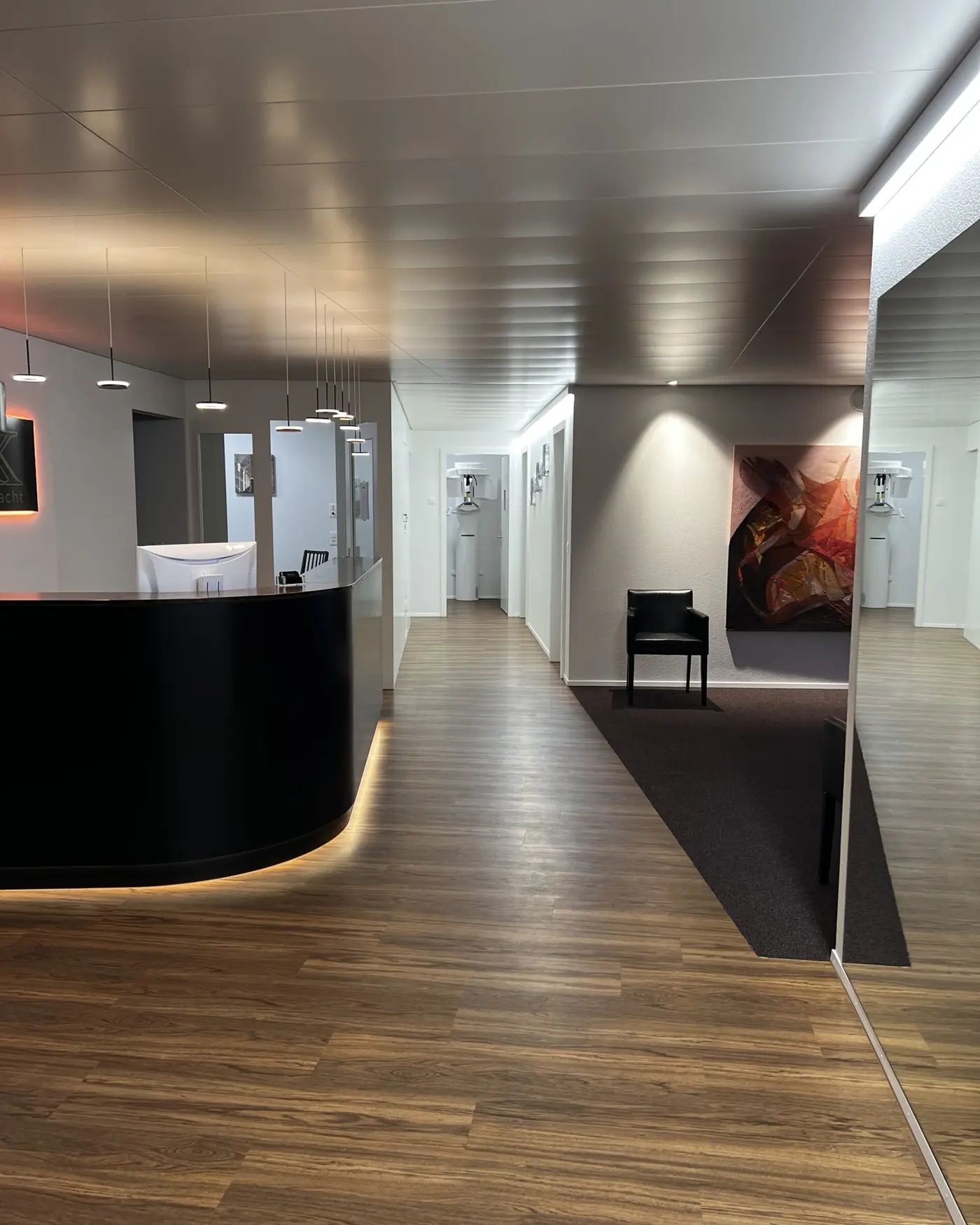
The clinic is at Goldbacherstrasse 3a, right by Küsnacht Goldbach station. There is parking, and the rooms are wheelchair and rollator accessible. The waiting room is pleasant. From Zurich HB (the main station) or Stadelhofen, the S6 and S16 run to Küsnacht Goldbach without a change. The trip takes about 7 to 10 minutes. A separate page shows the clinic's location in Goldbach. The contact page covers getting here by train or car.
Talking first, then the examination
At the start, tell us what makes you anxious and what has helped before. We examine your teeth and gums carefully and discuss the findings openly with you. As in any dental practice, we only treat you with your consent. You can read in advance what happens at a routine check-up.
What happens after your first appointment
If you need treatment, we discuss the steps and their order with you. We advise you openly on the costs. You decide when to continue.
What a medical certificate for dental phobia can do
Many people hope their insurer will pay if they have a certificate. But a certificate has a different job.
Who can diagnose dental phobia
Psychiatrists and psychotherapists diagnose a phobia, and often your family doctor (GP) does too. Zahnklinik Küsnacht does not make psychiatric diagnoses.
Why a certificate alone does not cover the costs
A certificate confirms the diagnosis. On its own, it gives you no right to have the costs covered. That depends on the legal requirements explained in the next section.
Advice from Germany and Austria does not apply here
If you search in German, many results on certificates come from Germany or Austria, where other rules apply. If in doubt, ask your health insurer directly.
Dental phobia and Swiss health insurance
In short: if you are anxious, the compulsory basic health insurance (Grundversicherung) pays for dental treatment only in narrow exceptions. The deciding rules are in the federal ordinance on health insurance benefits (Krankenpflege-Leistungsverordnung, KLV). This page describes them as of September 2026. Your health insurer (Krankenkasse) decides whether your case qualifies, not the clinic.
What basic health insurance does not usually cover
In Switzerland, basic health insurance does not usually cover dental treatment. The list of exceptions in the KLV is exhaustive, and dental anxiety is not on it. We bill transparently under the Dentotar tariff, with our tax point value (Taxpunktwert) of CHF 1.13. See tax points explained with dental hygiene.
The narrow exception in Article 18 KLV
Article 18 KLV names severe mental illness that seriously impairs the ability to chew. A dental phobia does not automatically qualify. Even then, the insurer only pays with special prior approval (Kostengutsprache). The approval takes into account the recommendation of the insurer's medical adviser (Vertrauensarzt). So you need to apply for it before treatment.
General anaesthesia costs under Article 19b KLV
Basic health insurance pays for a general anaesthetic in only two cases. The first is when a dental treatment it covers anyway is not possible without anaesthesia. The second is when a severe intellectual or physical disability prevents treatment without it. Article 19b does not mention anxiety. The professional manual of Swiss insurers' medical advisers says that anxiety is not usually a medical indication for general anaesthesia.
Psychotherapy for the anxiety itself
The anxiety itself can be treated, for example with behavioural therapy. Basic health insurance pays for psychotherapy by a psychologist if a doctor orders it. It does not cover the dental treatment.
Private dental cover and supplementary benefits
Supplementary dental insurance (Zahnzusatzversicherung) pays under its own terms. Your policy states what it covers for sedation or general anaesthesia. Supplementary benefits (Ergänzungsleistungen, EL) top up AHV or IV, the Swiss old-age, survivors' and disability insurance. If you receive them, the canton reimburses documented dental costs. Each canton decides which costs qualify.
How to calm anxiety before the dentist
These general tips can help. The appointment page lists what to bring to your first appointment.
- Write down your questions and worries and take the note with you.
- Ask someone you trust to come with you as far as the waiting room.
- Choose a time of day that leaves little time for brooding. You can state it in the form.
- Avoid coffee beforehand. It can make you more restless.
- Breathe calmly and breathe out for longer than you breathe in.
- Ask about breaks and whether you can interrupt with a hand signal.
Who will treat you at Zahnklinik Küsnacht
The medical director is Dr. med. dent. Susan Oswald-Schütz. She holds the Swiss federal diploma in dentistry, founded the clinic and is the team's laser expert. Carin Wirz has worked with her for more than 20 years. Dr. med. / med. dent. Arno König supports the team with a focus on outpatient cosmetic surgery, implantology and CEREC. We introduce the whole team in our team profiles.
I am grateful to work with such an experienced team.

Common questions about fear of the dentist
Is your question not listed? Call us or send us an email.
+41 44 915 17 77Do I have to say on the phone that I am anxious about the dentist?
No. If we know about it, we can take it into account at your first appointment. A short sentence in your written request works just as well.
Will the dentist start treating me at the first visit?
Not without your consent. First we examine you and discuss the findings openly. You help decide whether and when treatment follows.
It has been years since I saw a dentist and I feel embarrassed. Where do I start?
Start with a request, by phone or through the form. You do not have to justify anything. After the first examination, we discuss what is urgent and what can wait.
Will health insurance pay if I have a medical certificate for dental phobia?
Usually not. Basic health insurance only pays in cases listed by law. For mental illness, you also need prior approval. Check this with your insurer before treatment.
Is general anaesthesia at the dentist covered by basic health insurance?
Only as an exception. It pays if a covered treatment is otherwise not possible. It also pays if a severe intellectual or physical disability makes anaesthesia necessary. Anxiety alone is not usually enough.
Is therapy for dental anxiety covered by health insurance?
If a doctor orders it, basic health insurance pays for psychotherapy by a psychologist. It does not cover the dental treatment itself.
I am looking for a dentist for anxious patients in Zurich. How far is Küsnacht?
The clinic is in Küsnacht-Goldbach, not in the city of Zurich. From Zurich HB or Stadelhofen, the S6 and S16 run to Küsnacht Goldbach station without a change. The trip takes about 7 to 10 minutes. The clinic is right by the station.
Related pages
- Treatment without an injection using the laser
When treatment is possible without an injection, if the injection is what you fear most.
- Treating teeth with a dental laser
How the laser often replaces the drill at our clinic.
- Request your first appointment
The form, with space to mention your anxiety.
- Help with severe toothache
What to do about acute dental problems.
You can also ask us in writing
Request your appointment using the form or give us a call. The phone is not staffed during all opening hours. We are also happy to arrange appointments outside opening hours.