
Orthodontics guide
Aligners vs braces: differences, cost, wear time and age
Aligners or braces? The better choice depends on the type of misalignment, your age and your daily routine. Both move teeth slowly into a new position. This aligners vs braces guide explains the differences, wear time, cost and the right age for a first check-up. Invisalign® is a brand of clear aligners, so this comparison covers it too. The guide gives general information and does not replace an examination.
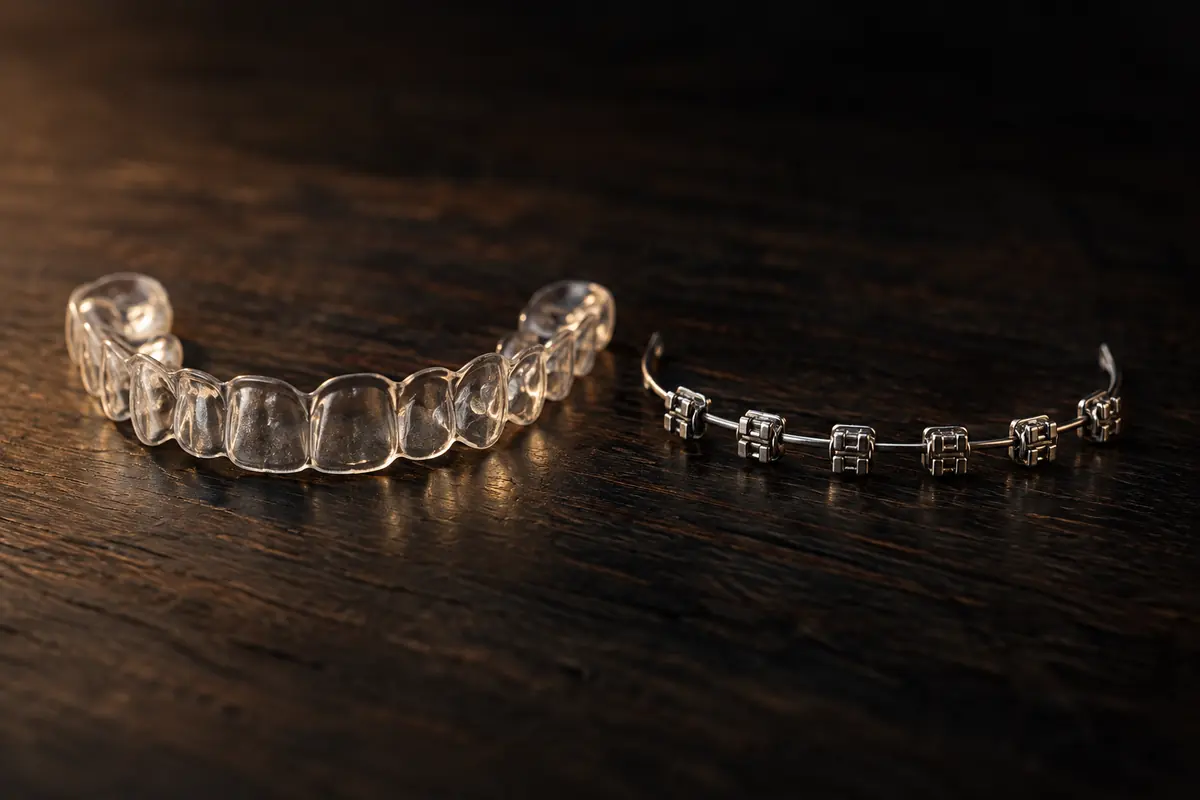
How aligners and braces move teeth
People usually say “braces” when they mean fixed braces. Any device that moves teeth is an orthodontic appliance. All of them use light, steady pressure to move a tooth slowly through the jaw.
Clear aligners as a series of removable trays
Aligners are removable trays made of clear plastic. A whole series is planned digitally in advance. Each tray moves the teeth a little further, and you switch to the next one at short intervals.
Planning uses a scan instead of impression material. Our page on digital impressions for aligner planning shows how it works.
Fixed braces with brackets and a wire
With fixed braces, small holders called brackets are bonded to the teeth. An archwire links them and passes the force on. Brackets are made of metal or tooth-coloured ceramic. Some are fitted behind the teeth (lingual braces).
Removable braces for children
A removable brace is a plastic plate with wire parts. It is mainly used in children who are losing their baby teeth, while the jaw is still growing. To move individual teeth in a targeted way, brackets or aligners are needed.
The difference between aligners and braces at a glance
The table mainly shows what is different in daily life.
| Feature | Clear aligners | Fixed braces |
|---|---|---|
| Visibility | clear and hard to see | visible, less noticeable with ceramic |
| Taking them out | yes, for eating and brushing | no, they stay on until treatment ends |
| Wear time and discipline | 20 to 22 hours a day, needs discipline | work around the clock |
| Eating and drinking | take them out first, only water with aligners in | avoid hard and sticky food |
| Cleaning your teeth | as usual, plus cleaning the aligners | more effort, small brushes between the brackets |
| Check-ups | regular, to check progress | regular, to adjust the wire |
| Suitable for | many misalignments, though not all equally well | many tooth movements, including difficult ones |
| After treatment | retainer needed | retainer needed |
General overview. Only the treatment plan shows whether a misalignment can be treated well with aligners.
Invisalign vs braces pros and cons
Neither option is better across the board. What matters is the misalignment and your daily life.
Pros of clear aligners
- The trays are hardly noticeable in conversation.
- You take them out to eat and to brush your teeth.
- No brackets or wires in your mouth.
- The expected result can be planned digitally in advance.
Pros of fixed braces
- They work around the clock, with no need to remember to wear them.
- They are suitable for many tooth movements, including difficult ones.
- They cannot be forgotten or lost.
Where aligners reach their limits
Aligners only work while they are in your mouth. If you often leave them out, you put the result at risk. Not every misalignment can be treated equally well with trays. That is why we first check whether your misalignment is suitable for aligners.
Cleaning your teeth during treatment
Plaque builds up easily around brackets and wires, which makes brushing more work. Thorough cleaning also matters with aligners. Anything hard to reach at home is removed by professional teeth cleaning during orthodontic treatment.
How many hours a day do you need to wear aligners?
Why 20 to 22 hours a day
We recommend a wear time of 20 to 22 hours a day. Aligners come out just for meals and tooth cleaning. Teeth move only while the pressure lasts. If a tray is out too often, the movement falls behind the plan, and the next tray fits less well.
Eating, drinking and brushing with aligners
- Take the aligners out before every meal.
- With aligners in, drink only water. Coffee, tea and sugary drinks can get trapped underneath.
- Brush your teeth before you put them back in.
- Carry the case when you are out, so no aligner gets lost.
- Frequent snacking eats into wear time.
The feeling of pressure after each new aligner
Each new aligner presses a little at first. This slight pressure usually lasts one to two days and shows that the teeth are moving. If the pressure lasts longer or an edge rubs, have the aligner checked.
Aligners or braces for kids, teenagers and adults
A misalignment affects the whole set of teeth, and narrow gaps between teeth are hard to clean. When treatment should start depends on the examination findings.
A first orthodontic check-up at age 7 or 8
We recommend a first orthodontic examination from age 7 or 8. At that age, the front teeth are being replaced by permanent ones, and the first permanent molars have come through. While the jaw is growing, its development can still be guided. The check-up may also show that no treatment is needed for now.
Teenagers with their permanent teeth
By about age 12 or 13, most young people have all their permanent teeth except the wisdom teeth. Individual teeth can then be moved in a targeted way, with brackets or aligners. Aligners require a lot of commitment.
Straightening teeth as an adult
Teeth can be moved at any age. As the jaw is no longer growing, planning is often more complex. Gums, crowns and fillings are checked first, and any inflammation is treated.
A case study on misaligned teeth in children and adults shows how examination and planning fit together.
Why you need a retainer after aligners or braces
Teeth tend to drift back towards their old position. That is why you need a retainer after any treatment, whether you had aligners or fixed braces. A retainer is either a fine wire behind the teeth or a removable tray. Which retainer suits you, and for how long, is decided case by case.
Aligners vs braces cost and Swiss insurance
Which is more expensive, aligners or braces?
It depends on the misalignment, the length of treatment and the appliance. That is why we only state the cost after a personal consultation. In the Swiss dental tariff, each treatment has a fixed number of tax points (Taxpunkte). The bill multiplies this number by the tax point value (Taxpunktwert). We bill transparently under the Dentotar tariff, with our tax point value of CHF 1.13.
What Swiss health insurance covers
As a rule, compulsory basic health insurance (Grundversicherung) does not pay for braces or aligners, even for children. The invalidity insurance (Invalidenversicherung, IV) covers recognised congenital disorders, such as cleft lip and palate. It pays for the necessary treatment until the patient's 20th birthday at the latest. It covers aligners only in rare exceptions. Supplementary dental insurance (Zahnzusatzversicherung) contributes to the cost, depending on your policy. Once a misalignment has been diagnosed, such a policy can usually no longer be taken out without an exclusion.
Aligners or braces? How to find out what suits you
A first impression with the smile simulation
A photo taken with your phone is enough to see how your teeth could look after aligner treatment. The selfie preview with the smile simulation is free and comes with no obligation. It does not replace a consultation with a dentist.
Examination and digital planning
At the examination, we scan your teeth digitally and, if needed, take digital X-rays. We then plan the treatment. The plan shows the expected result. It is not a promise.
Aligner treatment at our clinic
At our clinic, you can choose between two aligner systems, Invisalign® and Angel Aligner. For the steps, check-ups and retainers, read how treatment with Invisalign and Angel Aligner works. We clarify at your examination whether this suits you.
Frequently asked questions about aligners vs braces
Is your question not listed? Call us or send us an email.
+41 44 915 17 77Which is better, aligners or braces?
It depends on the misalignment, your age and how consistently you wear the trays. Aligners are less noticeable. Fixed braces work without any effort on your part. Only an examination shows which option makes sense for you.
How many hours a day do you need to wear aligners?
We recommend 20 to 22 hours a day, which includes the night. You only take the aligners out to eat and to clean your teeth.
Can you wear aligners only at night?
Not with Invisalign® or Angel Aligner. For both systems, we recommend 20 to 22 hours a day. If the wear time is too short, the teeth do not move as planned. The next aligner then fits less well, and the treatment takes longer.
Can you eat and drink with aligners in?
Take the aligners out to eat. While they are in, drink only water. Brush your teeth before you put them back in.
Which is faster, aligners or braces?
There is no general rule. The length of treatment depends mainly on how many teeth need to move and how far. With aligners, the wear time also plays a part.
At what age should a child have a first orthodontic check-up?
We recommend a first examination from age 7 or 8. It shows how the teeth and jaw are developing. Treatment does not necessarily start straight away.
Do you need a retainer after aligners or braces?
Yes, after both. Without support, the teeth gradually drift back towards their old position. A retainer is either a fine wire behind the teeth or a removable tray.
Are aligners covered by insurance in the same way as braces?
As a rule, basic health insurance pays for neither. The difference lies with the invalidity insurance (IV). It pays for recognised congenital disorders until the patient's 20th birthday, but covers aligners only in exceptional cases. With supplementary dental insurance, your policy decides.
Related pages
- Early signs of bleeding gums
Crowded teeth and braces make cleaning harder. How to spot inflammation early.
- All articles in the dental guide
On gums, implants, veneers, whitening and root canal treatment.
Assessing your tooth alignment
An examination shows which treatment suits you. Bring your questions about aligners and braces.