
Gentle treatment in Küsnacht-Goldbach
Tooth fillings in Küsnacht, from cavity treatment to tooth-coloured composite
With tooth fillings and other tooth-saving treatment in Küsnacht, we aim to keep your own teeth. This follows a basic principle of dentistry: “preserve before you replace”. We prefer to remove decay with a laser rather than a drill. Then we rebuild the tooth with composite or ceramic wherever possible. Our clinic is in Küsnacht-Goldbach, right by the station.
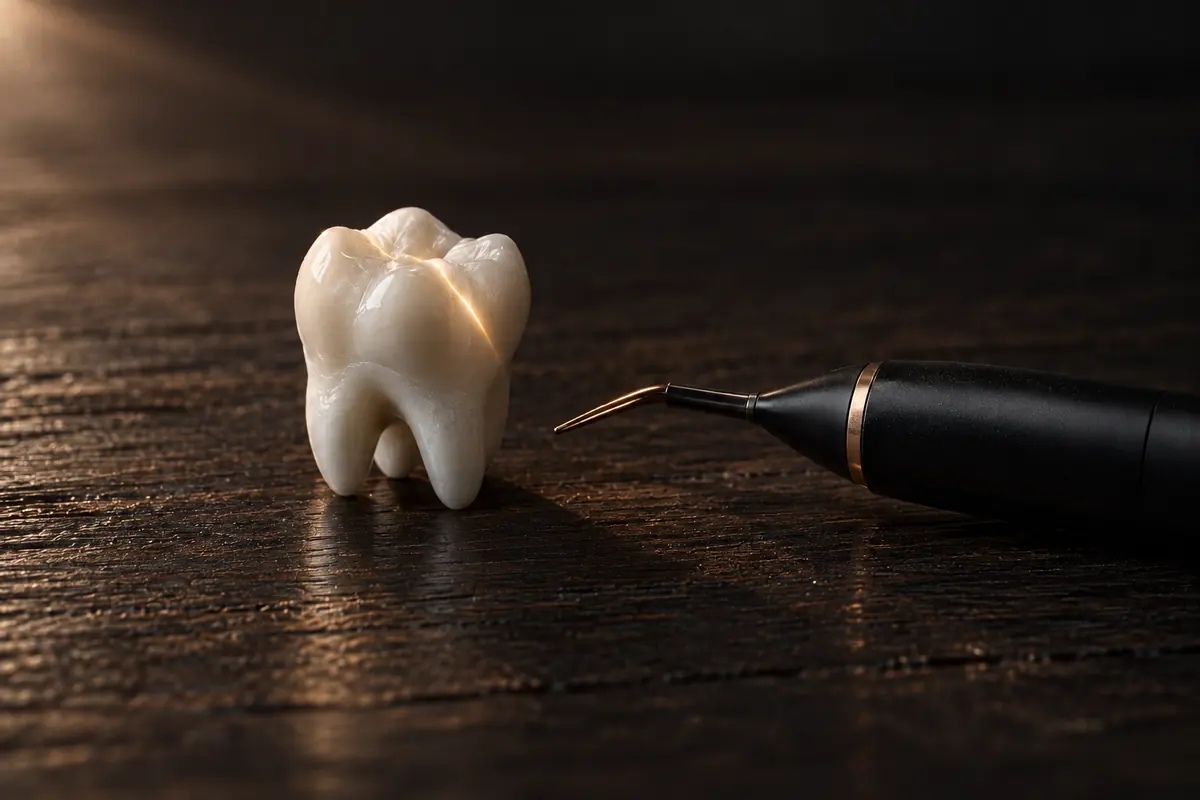
What saving a damaged tooth involves
Saving a tooth covers everything that keeps a diseased or damaged tooth in your mouth. These are the main steps:
- spotting decay early, while it is still small
- removing the decay while sparing healthy tooth structure
- closing the hole with a filling
- rebuilding larger damage with ceramic
- treating an inflamed tooth nerve
- keeping the tooth firmly held by gum and bone
This page explains how decay develops, what to do about a hole and when a tooth can still be saved.
How tooth decay and cavities develop
From plaque to a cavity
Tooth decay starts in plaque. The bacteria in it turn sugar from food into acid. This acid dissolves minerals from the enamel. If this continues, a hole, or cavity, forms. The decay then attacks the softer dentine. It spreads faster there than in the enamel and can reach the nerve.
Why early decay often does not hurt
Decay in the enamel usually does not hurt. Symptoms often start only when it reaches the dentine. The tooth then reacts to cold or sweet foods, for example. A tooth that does not hurt can still have decay.
How decay is spotted early
At a check-up we often find decay before it causes symptoms or needs extensive treatment. Our check-up page explains how a regular dental check-up works.
What to do about a hole in your tooth
Request an examination soon, even without pain
A hole in a tooth does not close by itself and tends to grow over time. Request an appointment soon, even if nothing hurts. The smaller the damage, the less treatment the tooth needs.
What you can do until your appointment
Temporary filling material from the pharmacy can briefly cover a hole. It does not replace treatment, though. Until your examination, these steps help:
- keep the area clean and brush gently
- chew on the other side
- avoid sweet and sticky food, and anything very hard
Lost filling or chipped tooth
A lost filling or a small chipped corner is usually not an emergency. But the spot is unprotected and often sharp. Have the tooth checked soon.
Severe pain or swelling
In a dental emergency, you can reach us on +41 44 915 17 77. Outside opening hours, our emergency phone +41 79 524 74 40 is for real emergencies only. For anything else, please send us an email or a WhatsApp message. Our emergency page tells you what to do about severe toothache.
How we treat cavities in Küsnacht
Cavity treatment at Zahnklinik Küsnacht has three steps.
Examination and discussing the findings
First, we examine your teeth and gums carefully. We discuss the findings openly with you. We take digital X-rays, and only when needed.
Removing the decay
Where possible, we use a laser to remove the decay. The laser then replaces the drill, and in many cases no injection is needed. For the local anaesthetic, we also use intraosseous anaesthesia. The anaesthetic is delivered directly into the bone next to the tooth. This numbs the tooth itself, and your lip and cheek usually do not go numb. A separate page explains when decay can be removed without an injection.
Rebuilding the tooth
We close smaller damage with composite, by hand and in layers. We restore larger damage with ceramic. We make it directly in the clinic with the CEREC system, in two to three hours.
Use our form to request an examination in Küsnacht.
How a composite filling is done
What composite is made of
Composite is a tooth-coloured resin. Fine particles of glass or quartz make it firm and hard-wearing. It is bonded to the tooth using what dentists call the adhesive technique. This usually means only the decay has to be removed, and hardly any healthy tooth structure is lost.
Matching the shade and building up in layers
First, we match the shade to your tooth. Then we build up the filling by hand in thin layers. Each layer is hardened with light. The aim is a filling that matches the colour of the neighbouring tooth.
When a filling is not enough
A filling is mainly suited to small and medium-sized damage. It is not enough for a large hole, a broken cusp or a cracked tooth. Ceramic can then rebuild the tooth more stably. Our page on ceramic with CEREC, usually in one visit explains how we make it.
Saving a tooth instead of extracting it
Where clinically justifiable, restorative dentistry aims to save a tooth rather than extract it.
Why keeping your own tooth is worthwhile
Your own tooth stays anchored in the jaw by its root. You can still feel how firmly you bite. Neighbouring teeth do not have to be ground down.
What the decision depends on
At your examination, we check whether your tooth can be saved. These four questions matter most:
- How much healthy tooth structure is left after the decay is removed?
- Is the tooth nerve inflamed, or has it already died?
- Is the root healthy, or does it have a crack?
- Is the tooth held firmly by gum and bone? Bleeding and receding gums are among the warning signs of gum disease.
When the tooth nerve is inflamed
If decay has reached the nerve, root canal treatment can often save the tooth. Read more about root canal treatment at Zahnklinik Küsnacht. Our dental guide explains whether a root canal still hurts today.
When a tooth cannot be saved
Sometimes extraction is the better choice. Reasons include too little remaining tooth structure, a root that has split lengthways or a very loose tooth. We then discuss the next steps with you. Our implant page describes when an implant can replace the tooth.
How much does a filling cost in Switzerland?
We do not quote a fixed price for a composite filling here, as every filling is different. We bill transparently under the Dentotar tariff, with our tax point value (Taxpunktwert) of CHF 1.13, and give you open advice on costs. In the dental tariff, each treatment has a set number of tax points (Taxpunkte). The amount is that number multiplied by the tax point value.
Basic health insurance (Grundversicherung) usually does not pay for dental treatment. Article 31 of the Health Insurance Act (KVG) allows narrow exceptions only. One example is a severe, unavoidable disease of the chewing system. The Federal Office of Public Health states that ordinary fillings for decay are not covered. Whether supplementary dental insurance (Zahnzusatzversicherung) pays depends on your policy.
If a tooth was chipped in an accident, report it promptly to your employer or insurer. Basic insurance pays for accidents only if no other insurance covers the costs.
The cost of a filling depends mainly on:
- how large the filling is and how many tooth surfaces it covers
- which material is used
- whether an anaesthetic is needed
- whether an X-ray is taken
Frequently asked questions about tooth fillings
Is your question not listed? Call us or send us an email.
+41 44 915 17 77Can tooth decay heal on its own?
No. Once a hole has formed, the tooth needs treatment. Only very early decay, where the enamel surface is still intact, can be stopped with fluoride and thorough care. The examination shows whether this applies to you.
How long does a composite filling last?
There is no fixed number of years. It depends on the filling's size and position, your oral care and whether you grind your teeth. The material itself is very robust.
Do composite fillings change colour over time?
With normal care, the filling keeps its light colour for a long time and is hardly noticeable. Coffee, tea, red wine and smoking can darken the surface a little over the years. Such stains can often be polished away.
What is the difference between composite and amalgam fillings?
Composite is tooth-coloured, while amalgam is a silver-grey metal filling. Composite is bonded to the tooth, so usually only the decay has to be removed. Amalgam is held in place mechanically. The hole needs a particular shape for this, and more healthy tooth structure is lost.
Is it normal for a tooth to be sensitive after a filling?
For a few days, the tooth may be sensitive to cold or when you bite. This is common and usually settles by itself. If it persists or biting hurts, please contact us. Sometimes the filling sits slightly too high and needs adjusting.
How long after a filling can I eat?
Composite is hard as soon as it is cured with light. If you had a local anaesthetic, wait until the numbness has fully worn off. That way you will not accidentally bite your cheek, lip or tongue.
Related pages
- Laser cavity removal instead of the drill
How we use the laser for decay and on the gums.
- Dental hygiene to help prevent decay
Removing plaque and tartar.
- CEREC ceramic for larger damage
Ceramic from our clinic when a filling is no longer enough.
We will take a look at your tooth
At the examination, we check whether a filling is enough or your tooth needs further treatment. Request an appointment or call us.