
Tooth shape guide
Porcelain veneers explained, from how they are made to how long they last
Porcelain veneers are wafer-thin ceramic shells bonded to the outer surface of a front tooth. This article explains how they are made and how much enamel is removed. It also covers how long they last and how to care for them.
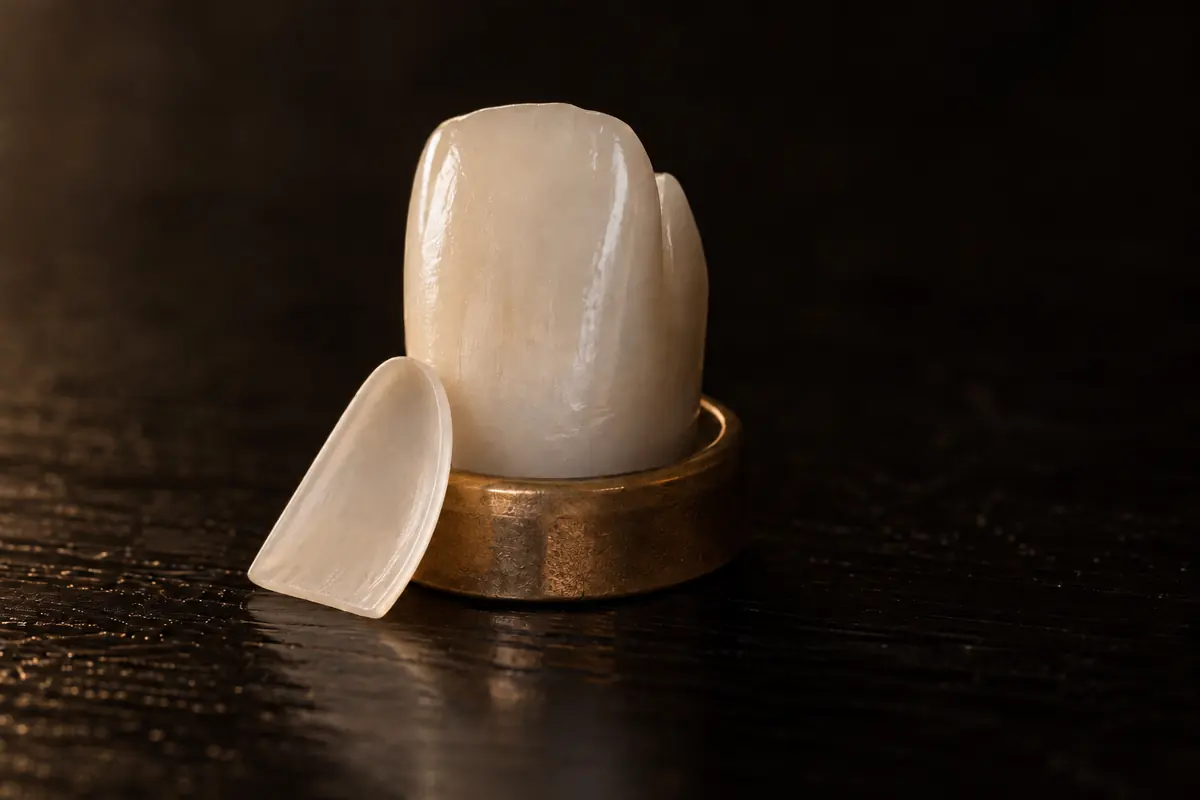
What porcelain veneers are
Veneers change the colour, shape and length of visible teeth, usually the upper front teeth. A separate guide explains what veneers cost and when whitening may be enough.
How a veneer is shaped and bonded
A veneer covers the front of a tooth. Some shells wrap over the biting edge. Others stop just short of it. Like tooth enamel, porcelain lets a little light through. The shell is fixed with a resin-based adhesive that bonds it firmly to the enamel.
Veneers vs crowns and fillings
A crown covers the whole visible part of a tooth. To make room for it, the tooth is ground down all the way round. A filling replaces lost tooth structure, for example after decay. A veneer sits only on the front and mainly changes how the tooth looks.
In 2002, a laboratory study by Edelhoff and Sorensen measured the difference on model teeth. For veneers, about a quarter to half as much tooth structure was removed as for a conventional full crown.
Porcelain vs composite veneers
Veneers can also be made from composite, a tooth-coloured resin. It is easier to repair, but it stains more readily and wears faster. Porcelain is harder and keeps its colour. For more on this material, see fillings and repairs with composite.
When veneers are an option and when they are not
Veneers are mainly an option for discoloured, chipped or irregularly shaped front teeth.
Your teeth and gums must be healthy beforehand. Decay and inflammation are treated first. A badly damaged tooth usually needs a crown. In people who grind their teeth heavily, veneers carry a higher risk. If teeth are noticeably crooked, clear aligners with Invisalign or Angel Aligner may be the better first step. We will check at your examination whether this is right for you.
How porcelain veneers are made
Dental lab or CEREC at the clinic
In a dental laboratory, a dental technician makes the shell from an impression or scan. This is done once the tooth has been prepared, that is, shaped for the shell. Until the shell is ready, a temporary restoration often protects the tooth. The shell is fitted at a second appointment.
With CEREC, the veneer is made at the clinic itself. The shell is designed on screen and cut from a ceramic block by a milling unit. It is then usually polished, or stained and glazed.
Making a veneer with CEREC in four steps
At our clinic, porcelain veneers are made with CEREC directly on site. Making them takes two to three hours. As a rule, one appointment is enough. The appointment and treatment are described under CEREC veneers in Küsnacht.
The four steps:
- Scan and planning: A scanner records your teeth in three dimensions, without impression putty and without gagging. We plan the shape and colour on screen, in a photorealistic view.
- Preparation: The tooth is prepared for the shell and scanned again so that the shell fits precisely.
- Production: With CEREC, the porcelain veneer is made at the clinic.
- Bonding: The finished veneer is bonded to the tooth.
There is more on how a digital dental impression is taken.
Matching colour and shape
We match the colour and shape to your own teeth. Besides the shade, the brightness and translucent biting edge of the neighbouring teeth matter. Our case study with discoloured front teeth shows the process from scan to bonding.
How much enamel is removed for veneers
For classic porcelain veneers, a thin layer of enamel is usually ground away. This makes room for the shell, so the tooth does not look thicker than before. As a guide, a 1992 study from the University of Siena suggested about half a millimetre. Only an examination can show how much would be removed from your teeth.
Why a thin layer of enamel is removed
Removing enamel makes room for the porcelain. But the removal should stay within the enamel where possible. The adhesive bonds better to enamel than to the dentine underneath. In 2024, a review in the Journal of Prosthetic Dentistry analysed six clinical studies. Veneers bonded to enamel held up more often and had fewer complications than veneers on exposed dentine.
What decides how much is removed
The amount depends mainly on these points:
- Position: A tooth that sticks out needs more removal than one that is set slightly back.
- Starting colour: A dark discolouration needs more porcelain so that it does not show through.
- Shape: If the tooth is meant to look longer or wider, the space needed changes.
- Enamel thickness: Near the gum line, the enamel is thinner than in the middle of the tooth.
Veneers with little or no enamel removal
Some veneers need very little enamel removal, or none at all. Dentists call them minimal-prep or no-prep veneers. This only works if there is enough room on the tooth, for example with small teeth or teeth set slightly back. Otherwise the tooth looks thicker afterwards.
Enamel removal cannot be undone
Enamel that has been removed does not grow back. A prepared tooth therefore needs a restoration permanently. That stays true when a veneer is replaced later. Take your time over this decision.
How long do porcelain veneers last?
Porcelain veneers are durable and, with good care, last for many years. How long a single veneer lasts depends on care, strain and the condition of the tooth beforehand. Nobody can predict it for one veneer.
What research says about veneer lifespan
In 2021, a review in the Journal of Clinical Medicine analysed 25 studies with around 6,500 porcelain veneers. After ten years, an estimated 95.5 per cent were still in use. A long-term study at the Medical University of Innsbruck followed 318 veneers for up to 20 years. The estimated survival rate was 93.5 per cent after ten years and 82.9 per cent after 20 years.
These are averages from studies, not results from our clinic. In both papers, porcelain fracture was the most common problem.
What shortens the life of veneers
In the Innsbruck study, the risk of failure was 7.7 times as high in people who grind their teeth. Veneers on teeth without a living nerve also failed more often. In everyday life, these things affect the shells most:
- Grinding and clenching, often unnoticed at night.
- Biting on hard things such as fingernails, pens or nutshells.
- Gums that recede and expose the edge of the shell. Look out for early warning signs in your gums.
- Decay at the edge of the shell if plaque is left there.
- Smoking, which can stain the edge.
What to do if a veneer chips or falls off
Keep the shell or the broken piece and call us on +41 44 915 17 77. Do not glue the veneer back on yourself, not even with superglue. The examination shows whether it can be bonded again or a new one is needed.
If the tooth hurts, or the tooth itself has broken, see our first steps in a dental emergency.
Veneer care at home and at the dentist
Veneers need no special care. Normal oral care and regular dental hygiene are enough. What matters is the edge where shell and tooth meet, because plaque easily builds up there.
Brushing and cleaning between teeth
- Brush twice a day with a soft or medium toothbrush.
- Clean between your teeth every day with floss or interdental brushes.
- Guide the brush gently over the line between shell and gum.
- Use a fluoride toothpaste without coarse abrasives.
Food, drink and habits
You can eat and drink as usual. The porcelain hardly stains, but the fine bonding line at the edge can discolour over time. If you grind your teeth at night, mention it at your check-up. A night guard is often recommended in that case.
Check-ups and dental hygiene
At a check-up, the edges, gums and bite are examined, so small damage is noticed early. Professional dental hygiene removes plaque even in places that are hard to reach with a toothbrush. Find out how often to have a dental check-up.
Common questions about porcelain veneers
Is your question not listed? Call us or send us an email.
+41 44 915 17 77Do porcelain veneers look thick or fake?
Porcelain veneers are wafer-thin. We make them with the CEREC system to fit your teeth precisely. We also match their colour and shape to the neighbouring teeth. So that the tooth does not look thicker, a little enamel is usually removed.
Does getting veneers hurt?
Tooth enamel has no nerves. Only the dentine underneath is sensitive. We discuss with you beforehand whether and how we numb the tooth. For local anaesthesia, we also use intraosseous anaesthesia: the anaesthetic goes directly into the bone next to the tooth, so your lip and cheek usually do not go numb. Our page on treatment without an injection explains when treatment is possible without anaesthesia.
Are veneers permanent?
The veneer itself can be removed, for example if it is damaged. But the tooth underneath has been ground down for the shell. It therefore needs a restoration afterwards, usually a new veneer.
Can you get a veneer on just one tooth?
Yes, for example on a chipped or discoloured front tooth. The main challenge then is matching colour and translucency to the neighbouring teeth. The examination shows whether a single veneer is enough.
Do porcelain veneers stain?
The porcelain itself hardly absorbs any colour. Over time, the fine bonding line at the edge can discolour, for example from smoking, coffee or red wine. Whitening products do not lighten porcelain.
Which toothpaste should you use with veneers?
A normal fluoride toothpaste is enough. Avoid highly abrasive pastes, such as some whitening toothpastes. Over time, they can roughen the smooth surface of the porcelain.
Can you get veneers if you grind your teeth?
Grinding and clenching put heavy strain on veneers. In a long-term study at the Medical University of Innsbruck, veneers failed considerably more often in people who grind. In some cases veneers are still possible, often together with a night guard. We will check at your examination whether this applies to you.
Related pages
- Veneers or teeth whitening compared
Costs, pros and cons of both options side by side.
- Treatment with CEREC at the clinic
How it works and how long it takes when veneers are made on site.
- More articles in our dental health guide
About gums, implants, aligners and more.
Advice on porcelain veneers
Only an examination can show whether veneers are an option for your teeth. Request an appointment or give us a call.