
Dental guide
Root canal pain and recovery: the procedure, how long it takes and the tooth afterwards
Many people associate a root canal with pain. Yet root canal pain usually comes from the inflamed tooth, not the treatment. This guide explains what you feel, how the procedure works and how long it takes. It also shows how the tooth is restored afterwards.
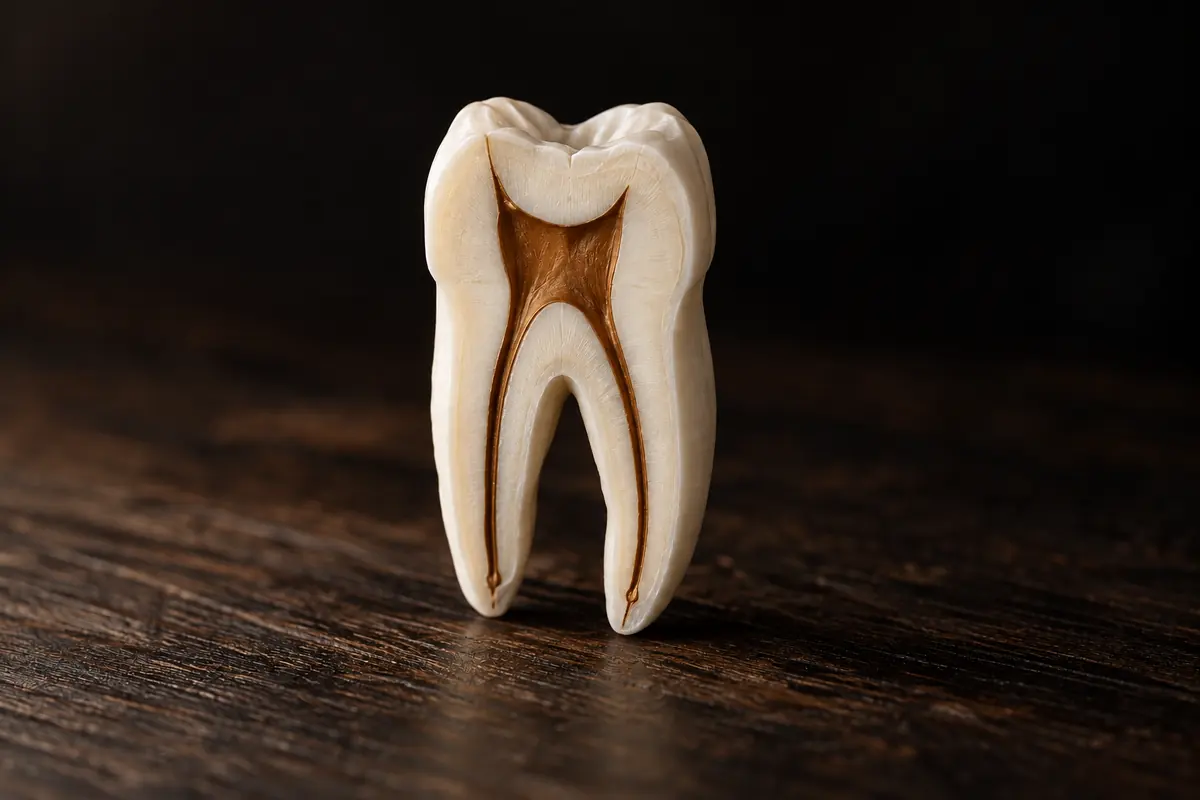
When the nerve inside a tooth needs treatment
How the tooth nerve becomes inflamed
Beneath the enamel and dentine lies the dental pulp, also known as the tooth nerve. It contains nerves and blood vessels and runs through the root canals to the root tips.
Bacteria usually reach the pulp through deep decay. A cracked tooth or an accident can also damage it. The tissue then becomes inflamed or dies. This rarely heals by itself and puts the tooth at risk over time. Our page on first aid for severe toothache explains what helps until your appointment.
Symptoms of an inflamed tooth nerve
If the nerve has already died, the tooth sometimes stays quiet. In that case, only an X-ray shows the inflammation. Common signs are:
- cold or heat hurts, and the pain lingers
- the tooth throbs, often for no reason and at night too
- biting and chewing hurt
- the gum or cheek swells
- the tooth turns darker
Does a root canal hurt?
Most people find a root canal under local anaesthetic similar to an ordinary filling. Often the treatment even relieves pain.
The pain usually comes before the treatment
Patients with an inflamed tooth often arrive after days of pain. That pain comes from the inflammation. The treatment removes the inflamed tissue, and with it the cause.
What you feel during the procedure
A local anaesthetic is usual for a tooth with a living nerve. For the local anaesthetic, we also use intraosseous anaesthesia. The anaesthetic is delivered directly into the bone next to the tooth. This numbs the tooth itself, and your lip and cheek usually do not go numb. You usually feel only pressure, plus the strain of keeping your mouth open for a long time. With a badly inflamed tooth, the anaesthetic sometimes works less well. Speak up at once if you feel more than pressure. Ask beforehand about a hand signal for breaks.
No treatment on a tooth is entirely without pain. With effective anaesthesia, though, a root canal usually involves relatively little pain. At our clinic, removing decay without an injection is possible with the laser in many cases. This applies to decay, not the root canal itself.
Where the bad reputation comes from
The bad reputation of root canals often rests on outdated information and second-hand stories. The pain of the inflammation is also easily blamed on the treatment, because both happen at the same time.
The root canal procedure step by step
Here is how a root canal usually proceeds. We work out what your tooth needs at the examination.
Examination and X-ray
The X-ray shows the number and length of the canals. It also shows whether the inflammation already reaches beyond the root tip.
Local anaesthetic and access to the canals
Once the anaesthetic has taken effect, a small opening is made, usually in the biting surface. It leads to the canal entrances.
Cleaning and rinsing the root canals
Fine instruments remove the tissue and widen the canals. Meanwhile, rinsing solutions disinfect them along their full length to the root tip.
Medication between appointments
Between two appointments, medication is placed in the canals. A temporary filling seals the tooth until the next visit.
Sealing the canals and rebuilding the tooth
The clean canals are sealed tightly with a filling material. An X-ray shows whether the filling reaches the root tip. The tooth is then rebuilt.
How long does a root canal take?
How many appointments you usually need
Most root canals need two appointments. The canals are not filled until the second one. Sometimes one is enough, sometimes more are needed. An appointment often lasts one to two hours.
What affects how long it takes
These points mainly decide how much work is involved:
- the number of canals: front teeth usually have one, back teeth generally two to three
- how far the inflammation reaches
- curved, narrow or branching canals
- an old root filling that must come out first
Until the tooth is fully restored
The build-up, filling or crown is a separate step. It should not be delayed long, or bacteria can get back in through any leaks.
Laser and digital X-rays at our clinic
Costs, the procedure and appointments at our clinic are covered on our page on root canal treatment in Küsnacht.
Laser to help disinfect the canals
We use the laser during the thorough cleaning of the canals. It kills bacteria there and helps to disinfect the canals. We then seal the canal tightly. Our laser page explains what the laser does in the root canal. The case study on an inflamed root canal shows one case from our clinic.
Digital X-rays at each step
We take digital X-rays, which use around 80 per cent less radiation than conventional methods. The images accompany each step of the treatment.
Root canal pain after treatment
How long the pain usually lasts
The tooth may be sensitive for a few days, especially when you bite. The tissue around the root is still recovering from the inflammation. This usually eases within days. An over-the-counter painkiller can help, taken as directed in the leaflet or after checking with us.
When to call us
Call us if you notice any of these signs. You can also reach us on +41 44 915 17 77 in a dental emergency. Outside opening hours, our emergency phone +41 79 524 74 40 is for real emergencies only. For anything else, please send us an email or a WhatsApp message. If needed, we can find an appointment outside opening hours too.
- the pain gets worse, not better
- your gum, cheek or face swells
- you get a fever
- the temporary filling falls out
- your bite feels too high
Restoring the tooth after a root canal
Why the tooth needs protection
Decay, old fillings and the access opening often remove much of the tooth's structure. The tooth then breaks more easily. Without a nerve, it also no longer feels cold or heat. New inflammation therefore often shows only on an X-ray. A tight, stable seal keeps new bacteria out and protects against fracture.
Tooth-coloured ceramic if a crown is needed
If a crown is needed, we make it from tooth-coloured ceramic. It is stable and hardly stands out next to the neighbouring teeth. With the CEREC system, it is made directly at the clinic, in two to three hours. Read more about a ceramic crown from the CEREC system.
How long does a root canal last?
There is no fixed figure. What matters is a tight seal, good care and regular check-ups, so that new decay is spotted early.
When the tooth cannot be saved
Reasons to keep your own tooth
Your own tooth keeps the familiar feel of chewing and preserves the bone around the root. Neighbouring teeth also do not drift into a gap. See our page on ways to save a natural tooth.
Retreatment, apicectomy or replacement
If the inflammation does not heal after treatment, the root filling can be renewed. Dentists call this retreatment. Another option is an apicectomy, a minor procedure that removes the root tip. If neither helps, the tooth is removed and replaced, for example with an implant or a bridge.
Frequently asked questions about root canal pain and recovery
Is your question not listed? Call us or send us an email.
+41 44 915 17 77Can you put off a root canal if the pain eases?
Better not. Pain that eases can mean the nerve has died. The inflammation does not heal, though, and it can spread to the bone at the root tip.
Can a tooth hurt again after a root canal?
Yes. Bacteria in a hard-to-reach canal, a leaking filling or new decay can cause new inflammation. Retreatment is then often an option.
Can I go to work after a root canal?
Usually yes, often on the same day. But your lip and cheek stay numb for a few hours, until the anaesthetic wears off.
What can I eat after a root canal?
Wait until the anaesthetic has worn off before you eat, or you may bite your cheek or tongue. Soft foods such as soup or pasta are a good choice for the first few days. Do not chew hard on the tooth until it is fully restored.
Does every tooth need a crown after a root canal?
No. It depends on how much tooth is missing and where it sits. Back teeth carry heavy chewing loads and usually need a crown or partial crown. For a front tooth, a filling is often enough.
Will the tooth look normal after a root canal?
Usually yes, because the small opening is sealed tightly at the end. Without a living nerve, though, the tooth can darken over time. Its colour can then often be matched to the other teeth. Options include whitening from the inside or a crown.
Will my severe toothache ease at the first appointment?
As a rule, we give you noticeable relief at the very first appointment. With an inflamed nerve, opening the tooth and removing the inflamed tissue often helps. The pressure inside the tooth then eases. If the pain is severe, call us on +41 44 915 17 77. Outside opening hours, our emergency phone +41 79 524 74 40 is for real emergencies only, and for anything else please send us an email or a WhatsApp message.
Related pages
- Treatment for severe dental anxiety
What helps with fear of the dentist.
- Check-ups for treated teeth
Spotting decay and gum disease early.
- Teeth cleaning in dental hygiene
Removing deposits, including below the gum line.
Get a painful tooth checked
We examine the tooth and tell you whether a root canal is needed. Appointments are also possible outside opening hours.