
Fixed replacement teeth with implants
Dental implants in Küsnacht: procedure and cost in Switzerland
At Zahnklinik Küsnacht, dental implants give you fixed, natural-looking replacements for missing teeth. That can mean a single tooth implant, or several implants if more teeth are missing. We plan implant treatment with a digital scan and digital X-rays. We carry out the procedure gently and use laser technology as part of it. Below, we explain who can have an implant, how the procedure works and what it costs. The clinic is in Küsnacht-Goldbach, right by the station.
What is a dental implant and when is it an option?
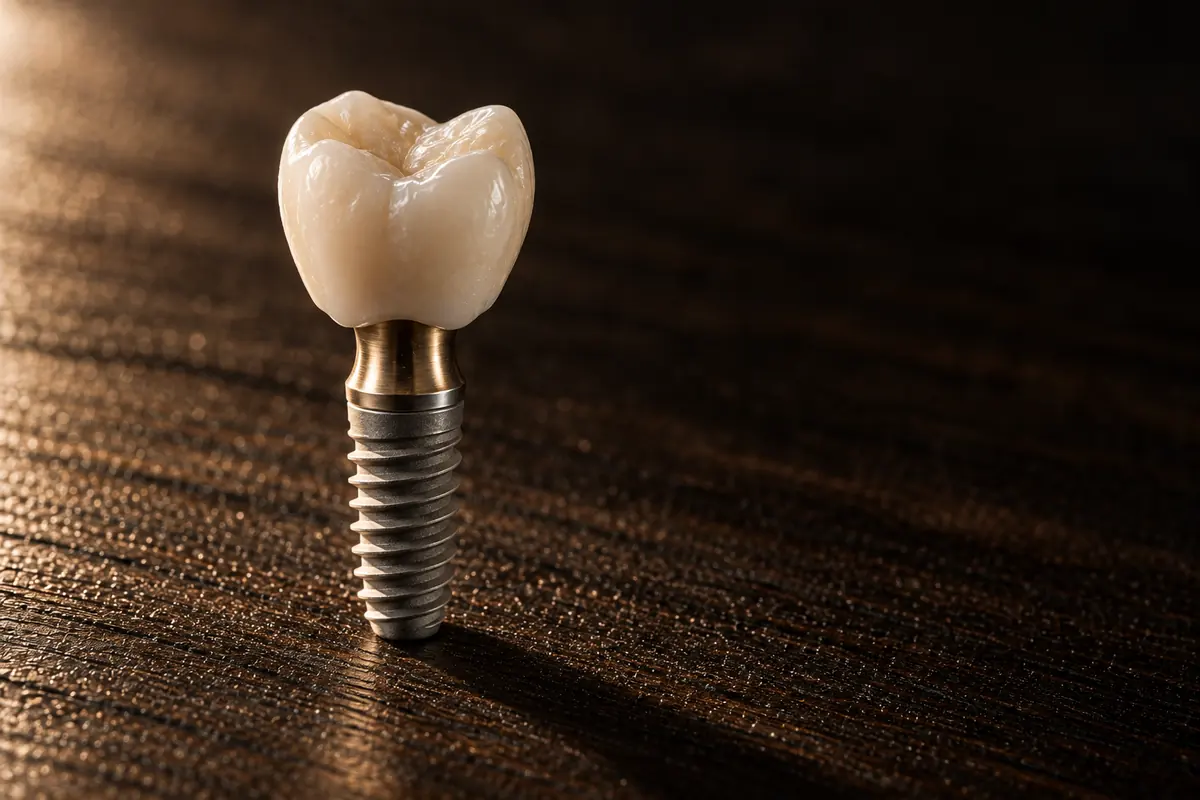
Implant, abutment and crown
A dental implant replaces the root of a missing tooth. It is usually a small screw anchored in the jawbone. Titanium is the usual material, but implants can also be made of ceramic. A connecting piece, the abutment, sits on the implant and holds the crown, the visible part of the tooth.
Single tooth implant for one missing tooth
If one tooth is missing, a single tooth implant with a crown closes the gap. Such a gap puts a strain on chewing and speech, and often on self-confidence. Our dental guide explains the benefits of implants compared with a bridge.
Implants for several missing teeth
Implants are also possible for several missing teeth. Not every missing tooth needs its own implant. The number depends on the gap and the bone.
Who can have a dental implant?
An implant is an option if one or more teeth are missing. At your examination, we check whether it is right for you. If the damaged tooth is still in place, the first question is whether it can be saved. See when a tooth can still be saved.
For an implant to heal well, these points matter most:
- enough jawbone where the tooth is missing
- healthy gums, with periodontitis (gum disease) treated first
- general health that allows normal wound healing
- thorough oral hygiene at home
- ideally no smoking, as it can disrupt healing
Digital implant planning with 3D scan and X-ray
Planning an implant requires an accurate picture of your teeth and jawbone. We use two digital methods.
A 3D scan instead of impression material
A small scanner captures your teeth in photorealistic 3D, with no impression material. The scan shows the gap and neighbouring teeth and is the basis for an accurate crown. See how the digital scan works.
Digital X-rays with less radiation
The X-ray shows the jawbone where the implant will go. Our digital X-rays use around 80 per cent less radiation than conventional methods. We take X-rays only when needed.
The consultation before implant surgery
Before placing the implant, we discuss the findings, your options and the cost. We take time for your questions. Please tell us about your medication and existing conditions. Some medicines and poorly controlled diabetes raise the risk of complications. Treatment only begins after a personal examination at the clinic.
The dental implant procedure step by step
Implant treatment usually follows six steps:
- Examination and consultation: we look at the gap and discuss your options.
- Digital planning: we use a scan and an X-ray.
- Surgery: the implant is placed in the jaw under local anaesthesia.
- Healing phase: the implant fuses with the bone.
- Crown: we attach a precisely fitting crown to the healed implant.
- Care: brushing, flossing and regular dental hygiene.
Implant surgery under local anaesthesia
We place the implant gently and under local anaesthesia. For the local anaesthetic, we also use intraosseous anaesthesia. The anaesthetic is delivered directly into the bone next to the tooth. This numbs the tooth itself, and your lip and cheek usually do not go numb. We use laser technology during the procedure. The laser keeps bleeding low and has an antibacterial effect. This supports healing. Our page on laser surgery in dentistry explains how else the laser is used. After the procedure, if it is necessary and you are eligible, our management will drive you home in our limousine.
How the implant heals into the bone
After the procedure, the bone grows onto the implant surface and bonds firmly with it. The technical term is osseointegration. It usually takes a few months, often longer in the upper jaw than in the lower. The final crown is generally fitted only after that.
A precisely fitting crown
Once the implant has healed, we attach the crown. Using the digital scan, we match its shape and colour to your neighbouring teeth.
Dental implant cost in Switzerland
Implant costs depend on your situation, so we do not list a fixed price here.
What the cost depends on
The main factors are:
- number of implants and position of the gap
- examination, X-rays and planning
- any bone grafting
- restoration on the implant, such as a single crown
- material and dental technician's work
- temporary solution during the healing phase
- number of appointments
How Swiss dental fees are calculated
In Switzerland, dental treatment is billed in tax points (Taxpunkte). Each service carries a set number of tax points. Tax points multiplied by the tax point value (Taxpunktwert) give the amount in francs. For patients who pay for treatment themselves, the Swiss Dental Association (SSO) publishes the Dentotar tariff. Depending on difficulty, it allows up to 15 per cent more or fewer tax points. Each practice sets its own tax point value, up to CHF 1.70. We bill transparently under the Dentotar tariff, with our tax point value of CHF 1.13.
Talk about the cost before you decide
We advise you openly on costs. Ask about them at the consultation, before you decide. The compulsory basic health insurance (Grundversicherung) does not usually cover implants. To talk through the costs, request a consultation about dental implants.
Caring for your dental implant
Brush and floss as with your own teeth
Care for an implant as you would your natural teeth. Brush thoroughly and clean between the teeth with floss or interdental brushes. Pay special attention to where the crown meets the gum. Plaque left there can inflame the tissue around the implant. Dentists call this peri-implantitis.
Dental hygiene and check-ups
Regular dental hygiene at the clinic is also part of implant care. One or two check-ups a year are usual. With implants, we set the interval individually after the examination. Our page on professional cleaning with ultrasound and AirFlow explains how the cleaning works.
Implant dentistry in Küsnacht
Implantology is the branch of dentistry that deals with implants. At our clinic in Küsnacht, it is one of five core areas, alongside tooth preservation, aesthetics, orthodontics and prophylaxis.
Who leads the clinic
Dr. med. dent. Susan Oswald-Schütz founded the clinic. She holds the Swiss federal diploma in dentistry and is its medical director. She covers the full spectrum of dentistry, with a focus on implantology and laser dentistry. Her technical areas of focus include laser surgery and minimally invasive treatment. She has passed three state examinations. Her path took her to the University of Zurich and the University of Basel. In New Orleans, she worked at Louisiana State University. She holds the Brånemark Master Diploma in implantology. She holds diplomas as a laser expert and as a laser safety officer and has 30 years of experience with the laser. She is a member of the SSO, SGI, CI and DGZI. Meet our founder and the team.
Getting here, parking and access
The clinic is at Goldbacherstrasse 3a in Küsnacht-Goldbach, right by the station. Parking is available, and the clinic is wheelchair and rollator accessible. For more on the location, see our page on the dentist near Küsnacht Goldbach station.
Frequently asked questions about dental implants
Is your question not listed? Call us or send us an email.
+41 44 915 17 77Does getting a dental implant hurt?
No dental treatment is entirely free of pain, and placing an implant is no exception. We give local anaesthesia and work gently. Any discomfort afterwards is usually mild and can be eased with painkillers. If you are very anxious, read what helps with dental anxiety.
How long does the dental implant process take, from first visit to crown?
Usually a few months, because the implant first has to fuse firmly with the bone. A bone graft makes treatment longer. At the examination, we discuss how long it will take in your case.
Does Swiss health insurance cover dental implants?
Usually not, because basic health insurance in Switzerland generally does not have to cover dental treatment. There are exceptions for certain serious illnesses. If an accident is the cause, accident insurance usually pays. Your policy shows whether your supplementary dental insurance (Zahnzusatzversicherung) contributes to the cost.
Do I need a bone graft before a dental implant?
It depends on how much jawbone there is at the site. The examination and the digital X-ray give an indication. If there is not enough bone, it can often be built up.
Is there an age limit for dental implants?
There is no fixed upper age limit. Good general health, normal wound healing and thorough oral hygiene matter more. For teenagers, an implant is only an option once the jaw and body have finished growing.
What can I eat after a dental implant?
It is best not to eat until the anaesthetic has worn off. For the first few days, choose soft foods such as soup, smoothies or pasta. Avoid hard, crumbly foods while the wound heals. After the procedure, we give you advice for your own case.
Related pages
- Dental implants in our dental guide
Benefits, lifespan and the comparison with a bridge.
- Digital scan at the clinic
Your teeth captured in 3D, without impression material.
- Laser dentistry at the clinic
Decay, gums and surgical procedures with the laser.
- CEREC crowns and veneers
Ceramic crowns and veneers that we make directly in the clinic.
Your dental implant consultation
Request your appointment using the form or give us a call. We are also happy to arrange appointments outside opening hours.