
Preventive dental care in Küsnacht-Goldbach
Dental hygiene cost in Switzerland: what to expect in Küsnacht
The cost of dental hygiene in Switzerland depends on the dental tariff and the work involved. That is why we do not quote a fixed price or publish a price list. Instead, this page explains how tax points and the tax point value make up the amount. You will also read what a price comparison in German-speaking Switzerland found, and what health insurance pays. We then show how we clean teeth gently in Küsnacht, with ultrasound and AirFlow. Duration, frequency, benefits and how to request an appointment follow.
How much does dental hygiene cost in Switzerland?
What professional teeth cleaning costs in Switzerland depends on the tariff and the practice's tax point value. The time your cleaning takes matters too.
Why we do not publish a fixed price
Instead of a flat fee, we bill transparently under the Dentotar tariff, with our tax point value of CHF 1.13. Sometimes teeth are clean after a short time. At other times, a lot of tartar has built up. That is why you will not find our prices on this page. We advise you openly on costs, so feel free to ask before your appointment.
How dental hygiene is billed in Switzerland
Dentists who belong to the SSO, the Swiss dental association, bill according to the dental tariff (Zahnarzttarif). For private patients, the tariff is called Dentotar. Each service carries a set number of tax points (Taxpunkte). That number roughly reflects the average time the service takes. Tax points multiplied by the tax point value (Taxpunktwert) give the amount on your bill.
Each practice sets its own tax point value, up to CHF 1.70 for private patients. For accident, military and disability insurance, the value is currently CHF 1.00. For dental hygiene, the longer it takes, the more tax points add up.
What affects the price of dental hygiene
Besides the practice's tax point value, these factors matter most:
- how much tartar and plaque have built up
- how long ago your last cleaning was
- the condition of your gums, such as deep gum pockets
- the number of teeth, and any implants, crowns or bridges
- additional services such as a check-up or, if needed, an X-ray
Dental hygiene prices in Zurich and the rest of Switzerland
Teeth cleaning prices vary widely. In 2019, the consumer magazine saldo compared prices at 20 dental practices in German-speaking Switzerland, including Zurich. One hour of dental hygiene with a qualified dental hygienist cost about CHF 130 to 250. Prices depended on the practice.
These are third-party figures from 2019, not Zahnklinik Küsnacht prices. Our clinic is in Küsnacht and has no location in Zurich.
Does Swiss health insurance pay for dental hygiene?
Compulsory basic health insurance (Grundversicherung) usually does not pay for dental hygiene. According to the Federal Office of Public Health, basic insurance does not, in principle, have to cover dental treatment. Exceptions include severe diseases of the chewing system that could not be avoided.
Your policy shows whether your supplementary dental insurance (Zahnzusatzversicherung) contributes. Before your appointment, check the percentage it pays and the annual limit.
What happens at a dental hygiene appointment in Küsnacht
For dental hygiene in Küsnacht, we use ultrasound and AirFlow. This is how an appointment with us works.
First, a look at your teeth and gums
If you come for a check-up and cleaning, we first look at your teeth and gums. We discuss the findings openly with you. Our check-up page explains what we check at a dental check-up.
Ultrasonic scaling for tartar, including below the gum line
Tartar is hardened plaque. Ultrasound loosens it, along with soft plaque. The instrument's fine tip vibrates very fast, and a water jet rinses the debris away. This lets us clean gently, even below the gum line.
AirFlow for plaque and stains
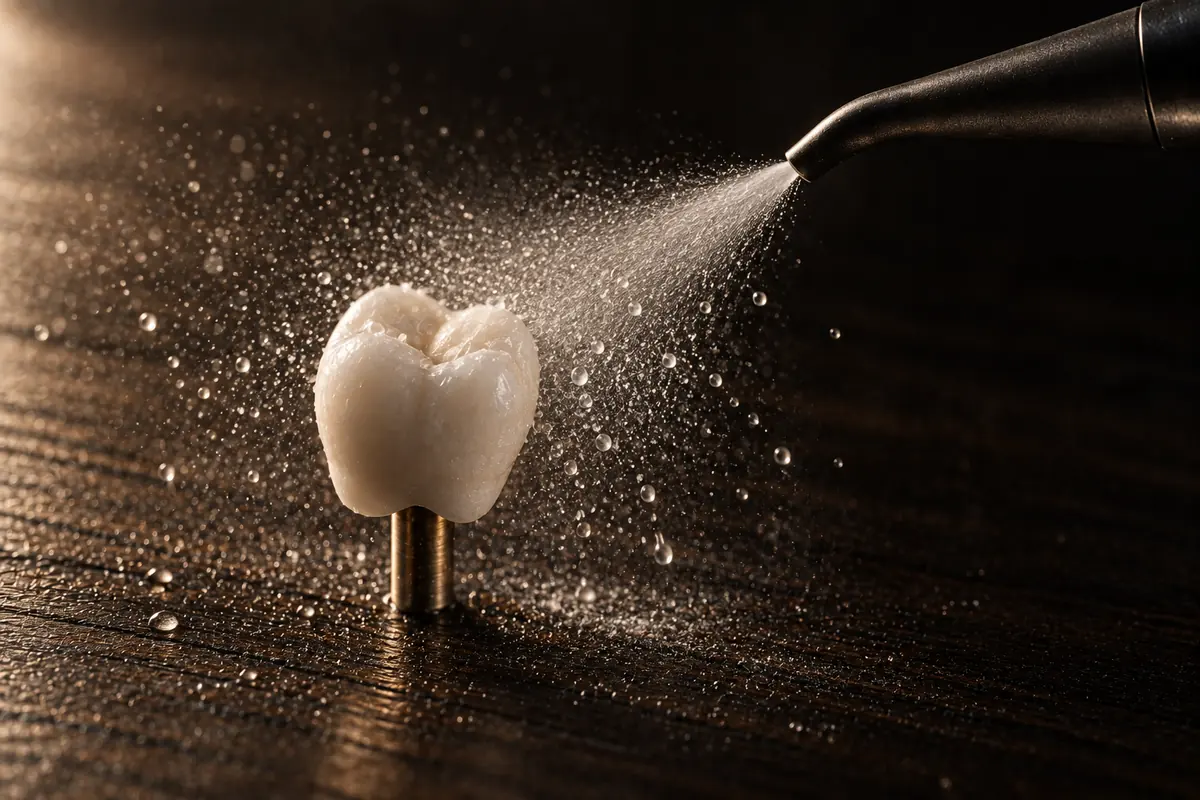
Next comes AirFlow, a standard part of our dental hygiene appointments. A fine jet of powder and water removes plaque and stubborn stains, for example from coffee, tea or red wine.
AirFlow cleans but does not whiten
AirFlow removes surface stains. It does not change the natural colour of your teeth. For lighter teeth, you need whitening. Read more about how whitening lightens your teeth. At our clinic, professional teeth cleaning comes before whitening.
Your oral care routine at home
Finally, we show you a simple care routine and the right technique for brushing and flossing.
How long does a dental hygiene appointment take?
We do not give a fixed duration here, as it depends on how much there is to clean. The saldo price comparison assumed one hour. That is a benchmark, not a set time for your appointment. When you request an appointment, ask how much time we will set aside for you.
What makes a cleaning take longer or shorter
The duration depends on the same factors as the price, because the tariff mainly reflects time. With regular cleanings, there is usually less tartar, so it is often quicker. It takes longer with fixed braces, for example, or where sensitive areas near the gum line need careful work.
How often should you have a dental hygiene appointment?
Usually once or twice a year, set individually
One or two check-ups a year are usual. We set how often a cleaning fits in after the examination. Regular cleaning removes new tartar before much of it builds up.
When more frequent cleanings can make sense
We work out the right interval for you at your examination. If your gums are inflamed, we clean the gum pockets with ultrasound and then treat them with a laser. Read more about laser gum treatment. A shorter interval can make sense in cases such as:
- inflamed gums or periodontitis
- implants
- fixed braces or aligners
- smoking
- tartar that builds up again quickly
Benefits of professional dental hygiene
Removing plaque where your toothbrush cannot reach
Even thorough brushing does not reach every spot. Plaque easily stays behind between the teeth and along the gum line. Over time, it hardens into tartar. Only a professional cleaning can remove it.
Helping to prevent tooth decay and gum inflammation
Bacterial plaque is a major cause of tooth decay and gum inflammation. Regular dental hygiene helps to prevent both. Our guides explain what bleeding gums can mean and what gum disease has to do with the heart.
Care for implants, veneers and whitening results
Look after implants like your own teeth, and keep up regular dental hygiene appointments. Plaque also tends to build up where crowns and veneers meet the tooth. See our tips on caring for porcelain veneers. After whitening, regular dental hygiene helps the result last longer.
Request a dental hygiene appointment in Küsnacht
To make an appointment, call +41 44 915 17 77 or request a dental hygiene appointment online. In the form, choose “Dental hygiene” and tell us whether this is your first visit.
Getting here by train or car
The clinic is at Goldbacherstrasse 3a, right by Küsnacht Goldbach station. Parking is available, and the clinic is wheelchair- and rollator-accessible. Our contact page gives directions to the clinic by train and car. For more about our location, see our page dentist by Küsnacht Goldbach station.
Finding a time that works for you
Appointments outside our opening hours are possible by arrangement. For dental hygiene, we also offer short-notice appointments. Our phone is not always staffed during opening hours. If you cannot get through straight away, please use the form.
Frequently asked questions about dental hygiene
Is your question not listed? Call us or send us an email.
+41 44 915 17 77Does dental hygiene hurt?
Most people find a professional cleaning comfortable. We use gentle techniques. If sensitive areas near the gum line or inflamed gums still bother you, just tell us. If you are very anxious, see help for anxious patients.
Is dental prophylaxis the same as dental hygiene?
Not quite. Prophylaxis means prevention, and at our clinic it includes dental hygiene and laser gum treatment. So dental hygiene is one part of prophylaxis. In everyday use, “professional teeth cleaning” usually means the same as dental hygiene.
Do I need to prepare for a dental hygiene appointment?
No special preparation is needed. Brush your teeth as usual. Before the treatment, tell us which medicines you take, especially blood thinners. Please also mention any existing medical conditions.
What should I expect after a dental hygiene appointment?
For a short while, your gums may feel tender and your teeth may be sensitive near the gum line. Slight gum bleeding usually settles within a few days. Please keep brushing as usual. If the discomfort continues, please call us.
Can I have dental hygiene while pregnant?
Usually, yes. Gums become inflamed more easily during pregnancy, so a thorough cleaning is particularly useful then. Please tell us beforehand that you are pregnant. We decide case by case whether an X-ray is needed.
Related pages
- Dental check-ups in Küsnacht
What happens at a check-up and when we take X-rays.
- Teeth whitening: process, cost and how long it lasts
For lighter teeth, when cleaning is not enough.
- Laser dentistry in Küsnacht
Using the laser for tooth decay and gum treatment.
- Bleeding gums: causes and warning signs
Spot the warning signs and keep your gums healthy.
Request a dental hygiene appointment
Choose “Dental hygiene” in the form or give us a call. We are happy to advise you on costs beforehand.