
Preventive care at the dentist
Dental check-up in Küsnacht: what to expect, digital X-rays and cost
At your dental check-up in Küsnacht, we examine your teeth and gums, even when nothing hurts. You will find us in Küsnacht-Goldbach, right by the station. This page explains what happens at a check-up and when we take X-rays. You can also read how often a check-up makes sense and how it is billed. Dental hygiene has its own page: how professional teeth cleaning works and what it costs.
Why a dental check-up makes sense even when nothing hurts
At a check-up, we can spot tooth decay and gum inflammation early, before they become painful or need more extensive treatment. According to the Swiss Dental Association (SSO), both diseases can largely be avoided or kept under control with good preventive care.
Early tooth decay usually goes unnoticed
Tooth decay (caries) starts as a chalky white spot in the enamel. At this stage, nothing hurts yet. Pain usually only begins once bacteria work their way through the dentine to the nerve. Decay between the teeth is hard to see in the mirror.
Spotting gum inflammation early
Gum inflammation usually does not hurt either. Periodontitis tends to develop slowly, often over years. Possible signs are bleeding gums, receding gums that make the teeth look longer, or bad breath. Our dental guide shows how to recognise unhealthy gums.
Why healthy gums matter beyond the mouth
According to the SSO, periodontitis increases the risk of cardiovascular disease. It can also have a negative effect on existing diabetes. The guide explains how gum disease and the heart are linked.
What happens at a dental check-up
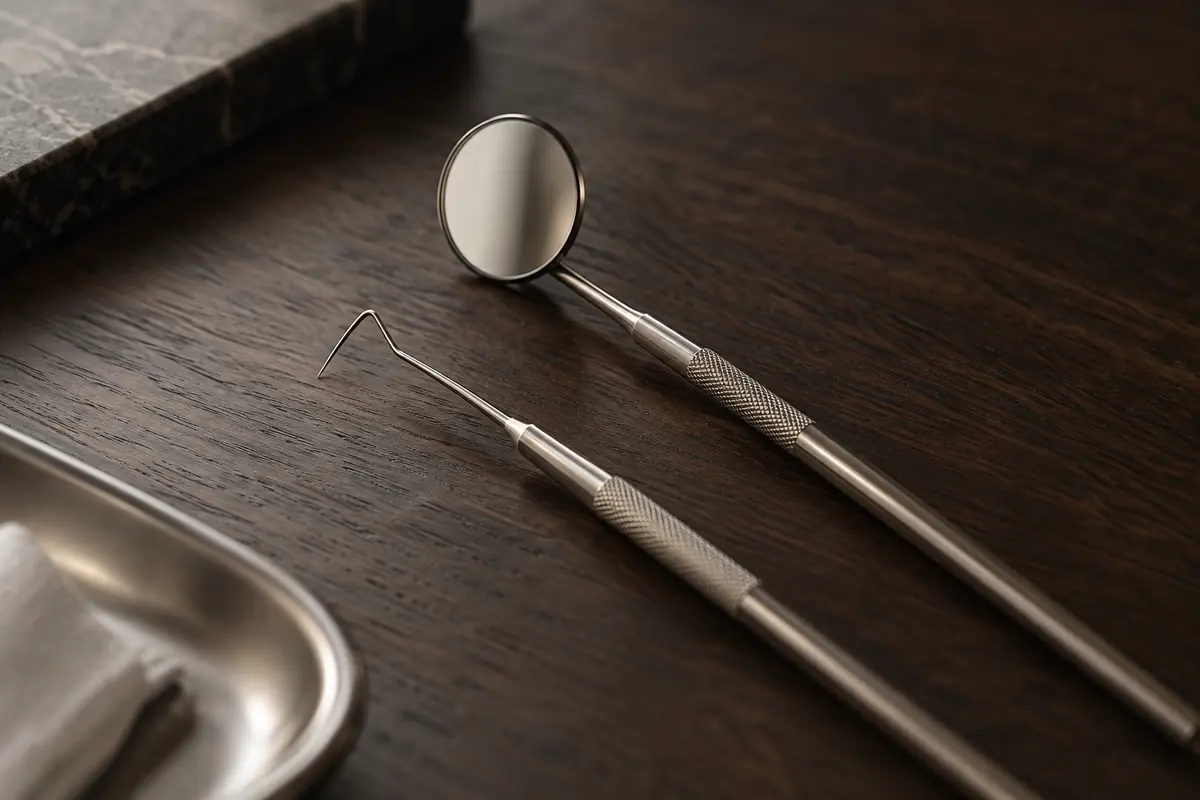
In general, a check-up covers your teeth, gums, the lining of your mouth and any existing fillings or crowns. You will also be asked about your health. At our clinic, preventive care includes these four steps.
Examining your teeth and gums
We look carefully at your teeth and gums and tell you openly what we find.
An X-ray only when it is needed
We take an X-ray only if the examination calls for one. We work digitally, which uses much less radiation.
Cleaning at a dental hygiene appointment
Preventive care also includes a dental hygiene appointment, where we clean your teeth with ultrasound and AirFlow.
Your results and a care routine for home
Finally, we show you a care routine suited to your teeth. This includes the right technique for brushing and flossing.
Digital dental X-rays with less radiation
A digital dental X-ray shows areas that cannot be seen just by looking into the mouth.
What a dental X-ray shows
The SSO notes that the spaces between the teeth cannot be judged properly by eye alone. An X-ray can show decay between the teeth or at the edge of an old filling. It also shows changes to the root and the jawbone.
The SSO quality guidelines say that how often X-rays are taken depends on your personal risk of disease. The principle is: as few X-rays as possible, as many as necessary.
Around 80 per cent less radiation
Compared with conventional methods, our digital X-rays use around 80 per cent less radiation. According to the SSO, dental X-rays are already low-dose procedures, and going digital has lowered the exposure further.
A digital scanner for photorealistic images
Besides X-rays, we use a digital scanner. It replaces impression material. Read how the digital scan captures your teeth.
How often should you go to the dentist for a check-up?
One or two check-ups a year are usual. We set the right interval for you after the examination.
The usual interval for adults
The SSO quality guidelines call for at least one dental check-up a year. Many countries have traditionally recommended a check-up every six months. A 2020 Cochrane review compared this fixed interval in adults with intervals based on personal risk. It found hardly any difference in tooth decay and bleeding gums.
When shorter intervals can make sense
A shorter interval can make sense if your risk of tooth decay or gum disease is higher. According to the SSO, signs of a higher risk include:
- two or more new cavities in the last three years
- bleeding gums, gum pockets or periodontitis
- implants, crowns or bridges
- smoking, diabetes or a weakened immune system
- producing little saliva, for example as a side effect of medication
- eating sweets frequently
If you haven't been to the dentist in years
If you have not seen a dentist for years, we will not judge you. We start with a thorough examination. If fear kept you away, read how we help anxious patients.
How much does a dental check-up cost in Switzerland?
We do not give a fixed price for a check-up here, because the cost depends on the work involved. We bill transparently under the Dentotar tariff, with our tax point value (Taxpunktwert) of CHF 1.13, and give you open advice on costs.
Tax points and the tax point value
In the SSO dental tariff (Zahnarzttarif), each of the more than 500 services has a fixed number of tax points (Taxpunkte). This number roughly reflects the average time the service takes. Multiplied by the tax point value, it gives the amount in Swiss francs.
What the cost depends on
For a check-up, these points matter most:
- the scope of the examination and the consultation
- whether X-rays are needed, and how many
- whether a dental hygiene cleaning takes place at the same appointment
- the clinic's tax point value
Basic and supplementary health insurance
As a rule, compulsory basic health insurance (Grundversicherung) does not cover dental check-ups and treatment. According to the Federal Office of Public Health (FOPH), there are only narrow exceptions. One example is a severe disease of the chewing system that could not have been avoided. If you have supplementary insurance (Zusatzversicherung), ask your insurer whether it pays towards a check-up.
Next steps after your check-up
After the examination, there are three typical outcomes.
No action needed
If everything is in order, we tell you when your next check-up makes sense.
We find tooth decay
Early decay that is still in the enamel can often be stopped without a filling. If a cavity has already formed, we frequently work with a laser instead of the drill. Read more about removing tooth decay with a laser and how we save a tooth with decay.
Your gums are irritated
Gum inflammation can clear up again. Good oral hygiene is what matters, and we show you the right technique. If periodontitis has already developed, we treat the gums, for example with the laser.
Dental check-ups in Küsnacht-Goldbach
Easy to reach from Küsnacht Goldbach station
The clinic at Goldbacherstrasse 3a has parking and is wheelchair and rollator accessible. Our page on the location of the clinic by Küsnacht Goldbach station has the details.
If you are in acute pain
If you have acute toothache, please do not wait for your next check-up. In a dental emergency, call us on +41 44 915 17 77. Outside opening hours, our emergency phone +41 79 524 74 40 is for real emergencies only. For anything else, please send us an email or a WhatsApp message. Our advice for acute toothache covers what helps until your appointment.
Frequently asked questions about dental check-ups
Is your question not listed? Call us or send us an email.
+41 44 915 17 77Is a dental check-up necessary if nothing hurts?
Yes. Tooth decay and gum inflammation usually do not hurt at first. At a check-up, we can spot them early, while they are small and easier to treat.
Do you really need a dental check-up every six months?
One or two check-ups a year are usual, with one as the minimum. The right interval depends on your risk of tooth decay and gum disease. We set it after the examination.
Do dentists take X-rays at every check-up?
No. We take X-rays only when needed. According to the SSO, how often you need one depends on your personal risk of disease. Our digital images use around 80 per cent less radiation than conventional methods.
Do you have to pay for a dental check-up in Switzerland?
We bill under the Dentotar tariff, with our tax point value of CHF 1.13: tax points multiplied by the tax point value. The amount therefore depends on the scope of the examination. Basic health insurance does not usually cover a check-up. Ask your supplementary insurer directly whether it pays anything towards it.
What is the difference between a dental check-up and a cleaning?
The check-up is the examination: we check your teeth and gums and explain the results. Dental hygiene is the cleaning: at our clinic, we use ultrasound and AirFlow to remove tartar, plaque and stains. Both are part of preventive care.
Can I have a check-up and a cleaning at the same appointment?
In the appointment form, choose “Check-up and prevention” under “Treatment you are asking about”. In “Your request”, mention that you would also like dental hygiene. We will then plan the appointments to suit you.
Related pages
- Dental hygiene in Küsnacht
How it works with ultrasound and AirFlow, how long it takes and the cost.
- Digital dental impressions in Küsnacht
What we use the scan for and how it works.
- Tooth fillings in Küsnacht
When a check-up shows decay or damage.
Request your dental check-up
Send us your request online or give us a call. We are also happy to arrange appointments outside opening hours.