
Dental health guide
Wisdom teeth removal near Zurich: when it is needed and how the costs work
Wisdom teeth removal is not always necessary. Some wisdom teeth never cause problems. Others press on the neighbouring teeth, become inflamed or damage them. We check how your wisdom teeth lie with digital X-rays, then discuss with you whether removal makes sense. This guide explains when a wisdom tooth should come out and how the procedure works at our clinic. You will also find out what is normal afterwards and who pays.
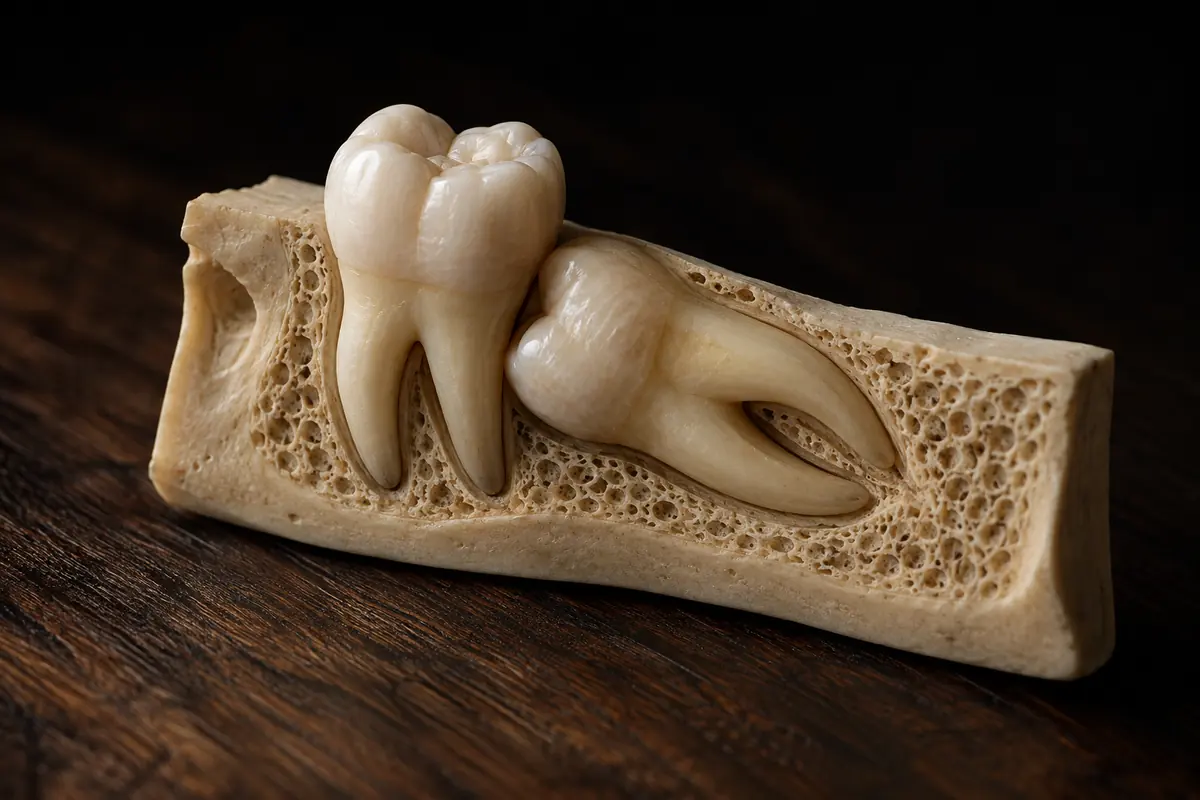
Why wisdom teeth so often cause problems
Wisdom teeth are the molars furthest back in the mouth, one on each side in the upper and lower jaw. They come through last, and there is often not enough room. This can lead to pressure and inflammation.
When there is not enough room in the jaw
If there is no room behind the other molars, the wisdom tooth can stay trapped in the bone. It may come through only partly or grow at an angle, and can then press against the neighbouring tooth. A gap often forms between the two teeth that is very hard to clean. Decay tends to start there.
What is an impacted wisdom tooth?
A wisdom tooth is impacted when it stays stuck in the jaw. This happens more often in the lower jaw than in the upper jaw. Three medical terms describe how the tooth lies:
- Fully impacted: the tooth stays completely inside the jaw, with no connection to the mouth.
- Partially erupted (partially impacted): only part of the crown shows above the gum. Food debris and bacteria can collect underneath.
- Angled or horizontal: the tooth lies tilted or sideways and does not grow in the usual direction.
When wisdom teeth should be removed
Whether a wisdom tooth should come out depends on what the examination and X-ray show. Some signs clearly point to removal. In other cases, the tooth can stay.
Signs that point to removal
- Inflammation, or pain from pressure, at the back of the jaw that keeps coming back.
- An inflamed flap of gum over a partially erupted tooth (pericoronitis).
- Too little room in the jaw, visible on the X-ray.
- Decay in the wisdom tooth that is hard to treat because of where the tooth sits.
- A cyst that has formed around the tooth.
- Damage to the neighbouring tooth, such as decay or loss of tooth structure at its root.
When a wisdom tooth can stay
A wisdom tooth can stay if it causes no symptoms, has fully come through and is easy to clean. The X-ray must also show nothing abnormal. Sometimes even a deep-lying tooth with no problems is better left where it is, if removing it would be risky.
We monitor such a tooth at your check-ups, with digital X-rays only when needed. Regular professional teeth cleaning keeps even the teeth at the very back clean. At your examination, we will check whether this applies to you.
Do wisdom teeth cause crowding?
A wisdom tooth with too little room can put pressure on the neighbouring teeth. Whether it also crowds the front teeth is disputed among specialists and has not been settled. On its own, this is no reason to remove a healthy wisdom tooth.
Orthodontic treatment may be planned or under way. Then we decide together whether the wisdom teeth would get in the way. A separate page explains how orthodontic treatment at the clinic works.
Wisdom teeth removal at Zahnklinik Küsnacht, near Zurich
We offer wisdom teeth removal in Küsnacht, on Lake Zurich. Our clinic is centrally located in Küsnacht-Goldbach, near the station. Parking is available, and the clinic is wheelchair and rollator accessible. For more on the location, see our dentist by Küsnacht-Goldbach station page. You will find directions by train or car on our contact page.
The procedure has three steps.
Assessment with digital X-rays
First, we assess exactly how the wisdom tooth lies, using digital X-rays with low radiation exposure. The image shows how much room the tooth has and how close it is to the nerve and the neighbouring tooth. Based on the image, we discuss with you whether the procedure is needed and when it should be done.
Anaesthetic and the procedure
Removing a wisdom tooth usually requires a local anaesthetic. For the local anaesthetic, we also use intraosseous anaesthesia. The anaesthetic is delivered directly into the bone next to the tooth. This numbs the tooth itself, and your lip and cheek usually do not go numb. Treatment without an injection is mainly possible when removing decay with the laser. A separate page explains when a treatment can be done without an injection.
We remove the tooth gently. The laser reduces bleeding during the procedure. Our laser page explains how we use the laser in surgical procedures. Laser surgery is one of the focus areas of our medical director Dr Susan Oswald-Schütz.
Guidance while you recover
We give you personal recommendations for the days after the procedure. Most patients are back to their daily routine after two to three days. How it goes for you depends on the position of the tooth and the extent of the procedure.
You can request an assessment of your wisdom teeth online or call us.
Pain after wisdom tooth removal and how recovery goes
After the procedure, a wound in the jaw needs to heal. Some pain and swelling in the first few days are part of that. How strong they are depends on the extent of the procedure. The laser can help to reduce bleeding and swelling.
What is normal in the first few days
In the first few days, it is common to have:
- Pain around the wound once the anaesthetic wears off.
- Swelling of the cheek and jaw, most noticeable in the first two to three days.
- A stiff jaw: for a few hours, sometimes a few days, your mouth does not open fully.
- Light bleeding on the first day, often just pink-tinged saliva.
Aftercare tips that help healing
These general tips apply unless we advise you otherwise.
- Cool your cheek from the outside, taking breaks.
- Do not rinse your mouth on the first day. Just spit out any blood.
- Avoid smoking, alcohol and strenuous exercise for the first few days.
- Sleep with your head slightly raised.
- Keep your tongue and fingers away from the wound.
- Brush your other teeth as usual, but avoid the wound.
- Take painkillers only after checking with us.
When to contact us straight away after the procedure
Contact us straight away if any of these signs appear. In a dental emergency, you can reach us on +41 44 915 17 77. Outside opening hours, our emergency phone +41 79 524 74 40 is for real emergencies only. For anything else, please send us an email or a WhatsApp message. Our advice for dental emergencies explains what to do.
- Bleeding that does not stop even after biting on a gauze pad for an hour.
- Pain that gets worse again from the third day, often with earache. This can be a dry socket, where the protective blood clot has come away from the wound.
- Fever, pus or swelling that keeps getting bigger after the third day.
- Numbness of the lip, chin or tongue that remains after the anaesthetic has worn off.
Possible risks we discuss with you beforehand
Every surgical procedure carries risks. Before the removal, we discuss with you which ones matter for your tooth. How high your personal risk is depends on the position shown on the X-ray.
Possible complications include:
- Bleeding after the procedure
- Swelling and bruising
- Infection of the wound
- Dry socket: the protective blood clot comes away from the wound too early.
- In the lower jaw, irritation of the nerve with numbness of the lip, chin or tongue. It usually passes.
- In the upper jaw, an opening into the sinus above the teeth (the maxillary sinus).
Wisdom teeth removal cost in Switzerland
The cost varies from case to case, so we do not give a fixed price here. It depends on the position and number of the teeth, the work involved and the X-rays needed. We advise you personally on the costs.
When basic health insurance covers the cost
In Switzerland, compulsory basic health insurance (Grundversicherung) usually does not pay for dental treatment. Article 17 of the Swiss health insurance benefits ordinance (Krankenpflege-Leistungsverordnung, KLV) names an exception. The exception covers impacted teeth whose condition amounts to a disease, for example with an abscess or a cyst. A tooth lying at an angle is not enough on its own.
Check with your health insurer before the procedure whether it will pay. If in doubt, request cost approval (Kostengutsprache). If you have supplementary dental insurance, the terms of your policy apply.
How the Swiss dental tariff works
We bill transparently under the Dentotar tariff, with our tax point value (Taxpunktwert) of CHF 1.13. In the Swiss dental tariff, each service has a fixed number of tax points (Taxpunkte). Multiplied by the tax point value, this gives the amount in Swiss francs.
Common questions about wisdom teeth
Is your question not listed? Call us or send us an email.
+41 44 915 17 77Do wisdom teeth always need to be removed?
No. A wisdom tooth that causes no symptoms and shows nothing abnormal on the X-ray can stay. There is no proof that removing symptom-free wisdom teeth as a precaution benefits your health. We keep an eye on the tooth at your check-ups.
At what age should wisdom teeth be removed?
There is no fixed age. It depends on what the examination shows. If a wisdom tooth has to come out, specialist dental societies recommend doing so before the age of 25 where possible. Later on, complications during removal are more common.
Does wisdom tooth removal hurt?
During the procedure, the area is numbed with a local anaesthetic. You feel pressure, but usually no pain. Afterwards, the wound hurts for a few days. In most cases, the pain eases considerably after two to three days.
Can all four wisdom teeth be removed at once?
It is possible, but not always sensible. Wisdom teeth can be removed one at a time or several in one session. If one side is left untouched, you can still chew on it. What suits you depends on the position of the teeth.
What can I eat after wisdom tooth removal?
Only eat once the anaesthetic has worn off. In the first few days, soft foods such as soup, smoothies and pasta are a good choice. It is better to avoid very hot, spicy or hard food. After the procedure, we give you personal recommendations.
Can a wisdom tooth cause ear pain?
Yes. Pain from an inflamed wisdom tooth in the lower jaw can spread to the ear. After removal, new pain that keeps getting worse, together with earache, is typical of a dry socket. If the examination finds no problem with the tooth, have your ear checked by a doctor.
Related pages
- What causes bleeding gums
How gum inflammation develops, including around a partially erupted wisdom tooth.
- Help with dental anxiety before the procedure
For anyone who feels anxious about having a wisdom tooth removed.
Have your wisdom teeth checked
We assess the position on a digital X-ray and discuss with you whether removal is needed. If you are in acute pain, it is better to call us.