
Tooth replacement and cosmetic dentistry
CEREC crown in Küsnacht and ceramic veneers, usually made the same day
We make your CEREC crown in Küsnacht directly in our clinic. With the CEREC system, ceramic crowns and veneers take two to three hours to produce. Instead of impression material, we use a digital scan. This means you usually receive your crown in one appointment, without a temporary crown. You can request an appointment for a crown or veneers straight away.
What CEREC is and how ceramic crowns are made in the clinic
CEREC is a computer-aided method that lets a dental practice make its own ceramic restorations, such as crowns and veneers. The method dates back decades. In 1985 in Zurich, a ceramic inlay made directly at the dental chair was fitted for the first time.
Traditionally, getting a ceramic crown at the dentist's takes several steps. After an impression is taken with impression material, an external dental laboratory makes the crown. Until it comes back, a temporary crown protects the tooth. The crown is then fitted at a second appointment.
With CEREC, the whole process stays in the clinic, from the scan and the design to the finished crown.
A digital scan instead of a putty impression
A small scanner captures your teeth in three dimensions, without any impression putty. This scan is the basis for planning. Our page on the digital scan covers digital dental impressions step by step.
Designed on screen, milled in the clinic
The crown is designed on screen from the scan data. A milling unit in the clinic then makes it from a ceramic block. At our clinic, this takes two to three hours.
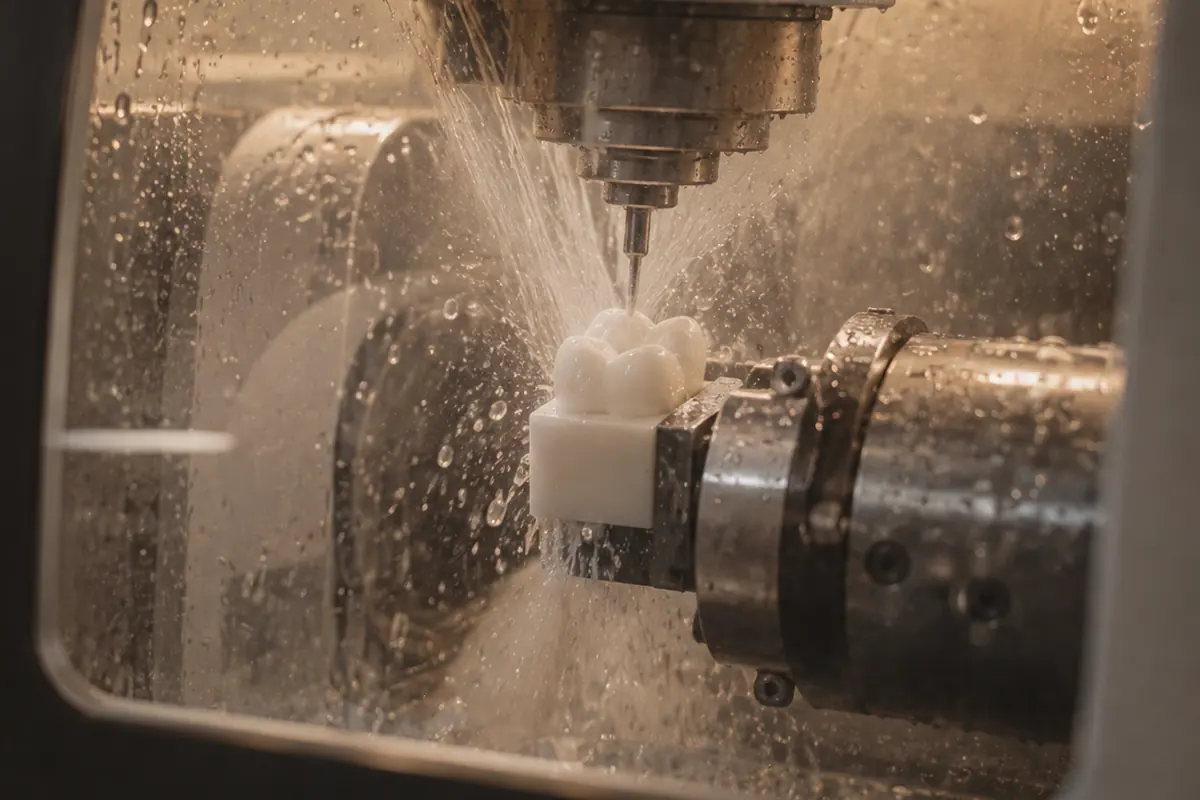
How a same-day crown usually works
The CEREC crown procedure step by step
An appointment for a CEREC crown usually follows six steps:
- Examination and discussion: We look at the tooth and check whether it needs a crown.
- Preparing the tooth: The tooth is usually shaped slightly all round to make room for the crown.
- Scan: Instead of using impression material, we record the prepared tooth with the digital scanner.
- Planning: We set the shape and colour of the crown on screen.
- Making it in the clinic: With CEREC, the crown is made on site in two to three hours.
- Fitting: The crown is usually tried in and the bite checked before it is fixed in place.
Why a temporary crown is usually not needed
Everything happens in one place. The crown does not go to a laboratory, so there is no waiting for it to come back. That is why you usually need neither a temporary crown nor a second appointment.
When a second appointment is needed
Not every tooth can be treated in one appointment. If the tooth nerve is inflamed, root canal treatment is usually needed first. Inflamed gums are normally treated before the crown as well. If several teeth need a crown, treatment can take longer or be spread over several appointments. At the examination, we check whether one appointment is enough in your case.
When a tooth needs a ceramic crown
Badly damaged or broken teeth
Deep decay, a broken-off part of the tooth or a very large old filling weakens a tooth. A filling then often no longer holds securely. A crown covers the tooth and restores its stability.
A crown for a root-treated tooth
After root canal treatment, a tooth has often lost much of its natural structure. If it then needs a crown, we make it from tooth-coloured ceramic. We also make this crown with CEREC in the clinic. A separate page explains how we carry out root canal treatment.
When a filling is enough or the tooth is missing
Minor damage can usually be repaired with a filling. The page on saving a tooth with a composite filling describes this option. If a tooth is missing entirely, the crown first needs a support, for example an implant. Read more about a dental implant for a missing tooth.
Veneers in Küsnacht, made with CEREC
For veneers in Küsnacht, we usually use the same process as for crowns.
What veneers are used for
Veneers are thin ceramic shells that cover the front surface of the front teeth. They are an option when these teeth are discoloured, chipped or irregular in shape. This applies especially when whitening alone is not enough.
CEREC veneers from scan to fitting
After the digital scan, we plan the veneers and match their colour to your own teeth. We usually make them with CEREC directly in the clinic. They are then bonded to the front teeth. In most cases, this takes one appointment.
What to know before you decide
For classic veneers, a thin layer of enamel is usually removed. The article on care and lifespan of porcelain veneers explains how much enamel is removed and how to look after veneers. Our dental guide also covers veneer costs and the comparison with whitening.
How natural a ceramic crown looks and how long it lasts
Colour and shape
We match the colour and shape of the crown to your neighbouring teeth using the digital scanner. The crown is planned on screen with photo-realistic images. The aim is a crown that is hard to tell apart from your own teeth.
Everyday care
A ceramic crown needs no special care. Normal brushing and flossing are enough. Plaque can build up where the crown meets the tooth, so regular check-ups are part of looking after it.
How long a ceramic crown lasts
With good oral hygiene, ceramic crowns often last 10 to 15 years or longer. How long a crown lasts depends on care and strain, for example from teeth grinding. That is why no one can give a firm promise about its lifespan.
Your CEREC appointment in Küsnacht-Goldbach
Zahnklinik Küsnacht is at Goldbacherstrasse 3a, centrally located in Küsnacht-Goldbach near the station. Parking is available, and the clinic is wheelchair and rollator accessible. Allow plenty of time, because making the crown alone takes two to three hours. While your crown is being made, you are welcome to take a seat in the waiting room. The page getting to Goldbach by S-Bahn or car describes the route.
Frequently asked questions about CEREC crowns and veneers
Is your question not listed? Call us or send us an email.
+41 44 915 17 77Can I get a crown in one day?
Usually, yes. With CEREC, we make the ceramic crown directly in the clinic, in two to three hours. That is why a temporary crown is usually not needed. The examination shows whether your tooth can be treated in one appointment.
What is a CEREC crown made of?
Our CEREC crowns are made of ceramic and have no metal framework. This means no dark metal edge can show through at the gum line. That can happen with crowns that have a metal core.
What is the difference between a crown and a veneer?
A crown covers the whole visible part of a tooth and stabilises it. It is mainly an option for badly damaged teeth. A veneer is a thin ceramic shell that covers only the front surface of a front tooth. It mainly changes colour and shape.
Will I need an anaesthetic for a crown?
That depends on the tooth and on the preparation it needs. Before treatment, we talk to you about whether we numb the tooth and how. For local anaesthesia, we also use intraosseous anaesthesia: the anaesthetic goes directly into the bone next to the tooth, so your lip and cheek usually do not go numb.
Does Swiss health insurance pay for a crown?
In Switzerland, dental treatment is usually not covered by the compulsory basic health insurance (Grundversicherung). Exceptions apply for certain serious illnesses and for accidents, if no other insurance covers the costs. Whether supplementary insurance (Zusatzversicherung) pays part of the cost depends on your policy. We bill transparently under the Dentotar tariff, with our tax point value (Taxpunktwert) of CHF 1.13, and give you open advice on costs.
Related pages
- Scanning your teeth in 3D
How the scanner records your teeth in three dimensions.
- Saving damaged teeth
When a tooth can manage with a filling.
- Weighing up veneers and whitening
Costs, pros and cons of both options compared.
The first step is an examination
At the examination, we check whether a crown, a veneer or a filling suits your tooth. We only make a recommendation once we have the findings. You can request a consultation about a crown or veneers or give us a call.