Teeth whitening guide
Teeth whitening at home in Switzerland with remedies, strips or trays
Teeth whitening at home takes many forms, but the products work very differently. Home remedies and whitening toothpastes mainly remove surface stains. Only a bleaching agent lightens the natural colour of your teeth, and that is usually hydrogen peroxide. In Switzerland, products on general sale may contain no more than 0.1% hydrogen peroxide. Stronger products are only available through a dental professional.
Ways to whiten your teeth at home and what to expect
Surface stains and the natural colour of your teeth
Surface stains, for example from coffee, tea, red wine or tobacco, sit on the enamel. The natural colour comes from inside the tooth, mainly from the yellowish dentine beneath the enamel. Over the years the enamel thins, and more of the dentine shows through.
The five methods at a glance
Here is what each of the five approaches can realistically do:
- Home remedies: at most, they remove surface deposits. The natural colour stays.
- Whitening toothpaste: removes surface stains.
- Strips and gels from shops: make teeth slightly to clearly lighter, depending on the product.
- Tray and gel from a dental professional: lightens the natural colour over several weeks.
- Whitening at the dental practice: works faster, with a more concentrated product.
How hydrogen peroxide whitens teeth
What happens in the enamel and dentine
Hydrogen peroxide passes through the enamel into the dentine. There it releases active oxygen, which turns dark pigments colourless. In the mouth, carbamide peroxide releases about a third of its weight as hydrogen peroxide. Sodium perborate and zinc peroxide also release hydrogen peroxide. The legal limits therefore include the hydrogen peroxide these substances release. Products advertised as peroxide-free use other bleaching substances.
Why fillings, crowns and veneers keep their colour
Bleaching agents only work on natural teeth. Fillings, crowns and veneers keep their colour and may look darker afterwards. Our restorative dentistry page explains how we replace composite fillings. We make ceramic crowns using the CEREC method directly at the clinic.
Hydrogen peroxide limits in Switzerland
In Switzerland, tooth whiteners count as cosmetic products. The key rule is Article 7 of the Ordinance on Cosmetic Products (VKos, SR 817.023.31, as at 1 January 2026). The Federal Department of Home Affairs issued the ordinance. The limits come from the EU Cosmetics Regulation:
- Up to 0.1% hydrogen peroxide: on general sale.
- Over 0.1% up to 6%: only through dentists and dental hygienists with a Swiss HF diploma.
- Over 6%: not permitted as a cosmetic product.
Up to 0.1% on general sale
Drugstores (Drogerien), pharmacies and online shops may freely sell toothpastes, mouthwashes, strips and gels with up to 0.1% hydrogen peroxide.
Over 0.1% to 6% only through a dental professional
Stronger products may only be supplied to dentists or dental hygienists with an HF diploma, not to beauty salons. The professional carries out or directly supervises the first application of each treatment cycle. After that, you may complete the cycle at home. These products must not be used on anyone under 18.
Whitening products from abroad or online
The same 0.1% limit applies in the EU. There too, stronger products are only supplied to dentists. Products with more than 0.1% are not on general sale in Switzerland, wherever they come from.
Home remedies for teeth whitening
Baking soda and baking powder
Baking soda (bicarbonate of soda) is relatively low in abrasiveness. In toothpaste, it has been shown to remove surface stains. It does not change the tooth's natural colour. Baking powder also contains an acidifying agent. Dentists advise against using either as a bleaching agent at home.
Acid from lemon, vinegar and strawberries
Fruit acid and vinegar dissolve minerals from the enamel. Within minutes, the enamel surface softens. Scrubbing then wears enamel away. Lemon with baking soda is therefore a poor choice. In one study, strawberries mixed with baking soda produced no measurable whitening.
Activated charcoal, coconut oil and turmeric
There is no evidence that activated charcoal whitens teeth safely and effectively. In the laboratory, it roughened the enamel. Nor is there reliable evidence for oil pulling with coconut oil or for turmeric. An overview:
- Removes surface deposits: baking soda.
- No proven whitening effect: oil pulling with coconut oil, turmeric.
- Can damage the enamel: lemon, vinegar, baking powder, coarse salt and activated charcoal.
Whitening toothpaste and drugstore products
What whitening toothpaste can do
Whitening toothpastes remove stains mainly with abrasive particles; some add a little peroxide. The dye blue covarine briefly makes teeth look less yellow. According to Stiftung Warentest in Germany, these pastes do not lighten teeth beyond their natural shade. The RDA value (Relative Dentin Abrasion) shows how abrasive a paste is. With exposed root surfaces or sensitive teeth, a low-abrasion paste is advisable.
Drugstore products from Germany
The German drugstore chain dm has no branches of its own in Switzerland. Products bought at dm in Germany or online fall under EU law. There, bleaching products on general sale have the same 0.1% limit as in Swiss drugstores and pharmacies.
Whitening strips in Switzerland
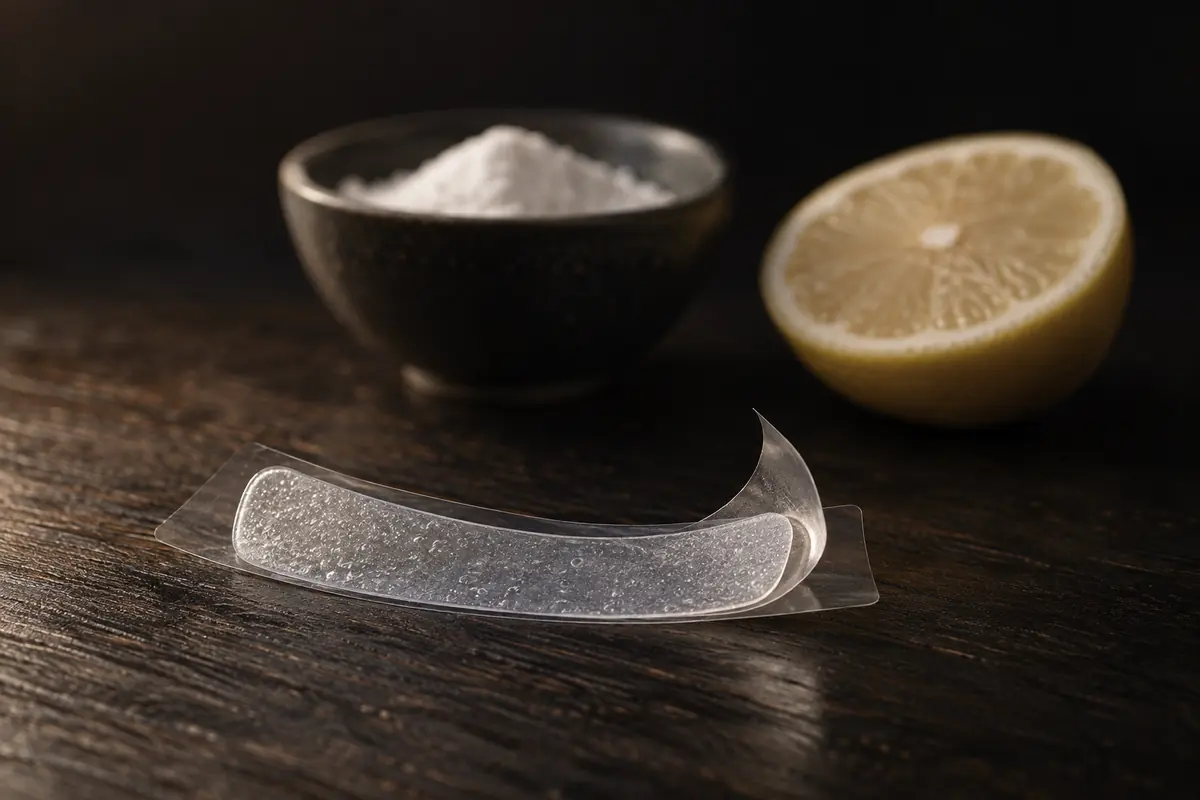
Whitening strips are thin films coated with gel. They are applied to clean, dry front teeth and canines. Strips on general sale contain no more than 0.1% hydrogen peroxide or other bleaching substances. In Switzerland, the same limit applies to strips bought abroad or online. On crooked teeth and between the teeth, the film often does not fit closely. The whitening can then be uneven. The gel can irritate the gums. The pack states how long and how often to use the strips, and lists the active ingredients under “Ingredients”.
Teeth whitening with trays
Custom-made trays or trays from a kit
For a custom-made tray, a dental practice takes an impression or a digital scan. The thin tray fits closely and holds the gel against the teeth, so little gel reaches the gums. Trays from a kit fit less precisely. The matching gels on general sale contain no more than 0.1% hydrogen peroxide.
Why tray whitening starts at the dental practice
Gel with more than 0.1% hydrogen peroxide is only available through a dental professional. The professional first checks your teeth and gums and carries out the first application of each treatment cycle. After that, you continue at home, following their instructions and attending check-ups. Depending on the gel, the whole course takes several weeks.
Risks and side effects of whitening at home
According to the Federal Food Safety and Veterinary Office (FSVO), side effects depend on concentration, frequency and duration of use.
Sensitive teeth and irritated gums
Most often, teeth become temporarily sensitive or the gums become irritated. The FSVO also lists damage to fillings or dental prostheses. It links frequent use to an increased cancer risk, especially with tobacco use, alcohol abuse or a hereditary predisposition.
When a dark tooth has another cause
A single dark tooth may be discoloured from the inside after an accident or root canal treatment. Tooth decay can also darken a tooth. Whitening does not remove these causes. With decay, cracks or fillings that no longer seal at the edges, the product can enter the tooth and cause inflammation.
Who should not whiten their teeth at home
The following people should not whiten their own teeth at all, or only after an examination:
- People under 18
- People who are pregnant or breastfeeding, according to Stiftung Warentest
- People with inflamed gums (more on what bleeding or inflamed gums can mean)
- People with exposed root surfaces or sensitive teeth
- People with many visible fillings or crowns
What tests of at-home whitening products show
We do not test products or name brands. In April 2026, Stiftung Warentest in Germany tested 13 products for home use, including strips, serums and gels. It mainly assessed how well they whiten and how gentle they are on the enamel. All of them lightened the teeth, some strongly, others only slightly.
Checklist before you buy a whitening product
- The active ingredient is listed under “Ingredients”.
- Products on general sale contain no more than 0.1% hydrogen peroxide.
- The duration and number of applications are clearly stated.
- Warnings and clear instructions are included.
- No whitening with acid such as lemon or vinegar.
- Realistic expectations: no Hollywood smile.
- Your teeth and gums have been checked beforehand.
When whitening at the dentist makes more sense
For light stains, home products can be enough.
Situations where the dental practice can do more
- You would like a clearly lighter natural colour.
- A single tooth is darker, for example after root canal treatment. The dentist can lighten it from the inside.
- The stains are uneven, or your teeth are sensitive.
- Fillings or crowns need to be part of the plan.
- The shape of your teeth also bothers you. Then read when veneers are an option instead of whitening.
Check-up and cleaning before whitening
For whitening at home or at the practice, a dental check-up beforehand is the sensible first step. For example, it lets us detect tooth decay and gum disease early. During a dental hygiene appointment before whitening, we loosen plaque and tartar with ultrasound. We remove surface stains with AirFlow. This cleans the teeth but does not bleach them. Cleaning alone can make the original colour of your teeth visible again.
Whitening at Zahnklinik Küsnacht
At our clinic, we first clean the teeth professionally and then lighten them with a power light. We will check at your examination whether this is right for you. Our page on teeth whitening cost in Switzerland also explains the procedure and how the price is set.
Frequently asked questions about teeth whitening at home
Is your question not listed? Call us or send us an email.
+41 44 915 17 77Does teeth whitening at home actually work?
Yes, within limits. Toothpaste and baking soda remove surface deposits, and bleaching products on general sale lighten the teeth somewhat. But do not expect a Hollywood smile.
Is there a home remedy for teeth whitening that works?
No home remedy lightens the natural colour of your teeth. Baking soda removes surface deposits, so the teeth look cleaner. Lemon, vinegar, salt and baking powder, however, can attack the enamel.
Is hydrogen peroxide from the pharmacy suitable for whitening teeth?
No. In Switzerland, whiteners with more than 0.1% hydrogen peroxide are only available through a dental professional, who checks your teeth and gums first. Used on your own, hydrogen peroxide can make teeth sensitive and irritate the mouth.
Are dm teeth whitening products available in Switzerland?
Not in dm shops. The drugstore chain has no branches of its own in Switzerland. Products bought from dm in Germany or online fall under EU law. There, as in Switzerland, the limit on general sale is 0.1% hydrogen peroxide.
How old do you have to be to whiten your teeth?
Under the Ordinance on Cosmetic Products, you must be 18 to use products with more than 0.1% hydrogen peroxide. Stiftung Warentest also advises children and teenagers against weaker products.
Which at-home whitening products do well in tests?
We do not name brands. In April 2026, Stiftung Warentest tested 13 products for home use, with grades from good to adequate. Its individual results are only available for a fee.
Related pages
- Professional teeth whitening in Küsnacht
Cleaning, power light and costs at the dentist.
- Veneers or teeth whitening: how to decide
When whitening is enough and when ceramic shells are an option.
- Steps of a dental hygiene appointment
How ultrasound and AirFlow remove deposits.
Have your teeth checked before whitening
At a check-up, we can tell you whether your teeth are suitable for whitening at home.