
Tooth replacement guide
Benefits of dental implants: implant vs bridge, which is better?
The benefits of dental implants go beyond closing a gap. A gap in your teeth often makes chewing and speaking harder. Some people also feel less confident because of it. An implant replaces the root of the missing tooth. It passes chewing pressure on to the jaw in a similar way to a natural root. The neighbouring teeth stay untouched. Even so, a bridge is sometimes the better fit. This guide compares both options and explains how long an implant lasts.
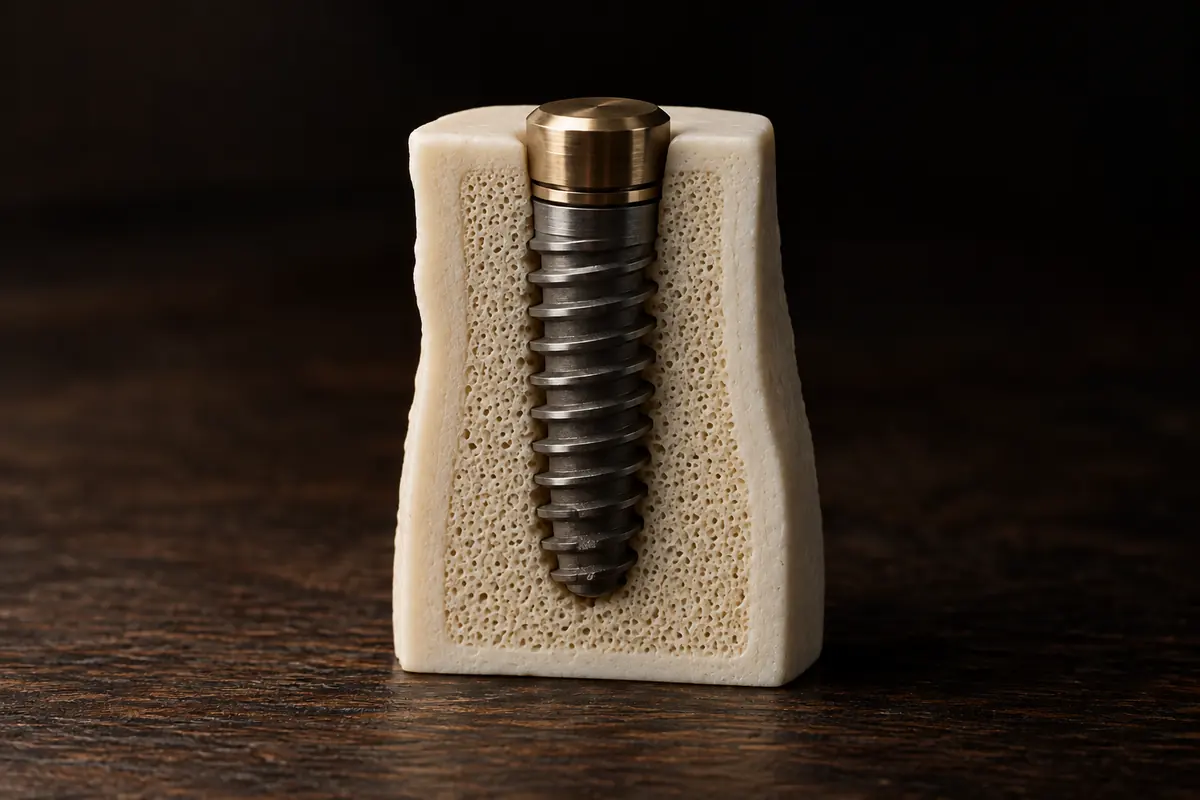
How a dental implant replaces a tooth root
Root, abutment and crown
A dental implant is an artificial tooth root, usually shaped like a small screw. It is placed in the jawbone and fuses firmly with it over the following months. A connecting piece, the abutment, goes on top. It holds the crown, the part you see when you smile. Most implants are made of titanium, some of ceramic.
Replacing one tooth or several
If one tooth is missing, an implant carries a single crown. If several are missing, implants can also carry a bridge or hold a denture in place. At our clinic, we place implants for a single missing tooth or for several.
The benefits of dental implants
Four points count in favour of an implant. Its lifespan has a section of its own further down.
- The jawbone takes the pressure of chewing, in a similar way to a natural root.
- Healthy neighbouring teeth do not need to be ground down.
- The replacement tooth is fixed in place. You do not take it out.
- The crown looks much like a natural tooth and feels similar.
An implant stimulates the jawbone like a natural root
When you chew, the tooth root passes the pressure into the jawbone. This pressure keeps the bone in shape. An implant takes over this task. So it can help prevent bone loss at that site.
Healthy neighbouring teeth stay untouched
For a conventional bridge, the teeth next to the gap are ground down and crowned, even when they are healthy. The removed tooth structure does not grow back. An implant, by contrast, stands on its own in the gap.
A fixed tooth for chewing and speaking
Once it has healed in, an implant is firmly anchored in the jaw. You do not take out the crown on top, and it does not slip while you eat. It also stays in place when you speak.
Looks and feels close to a natural tooth
The crown is matched to the neighbouring teeth in shape and colour. Even so, an implant does not feel exactly the same. A natural tooth sits in the periodontal ligament, a tissue with fine nerves that registers even light pressure. An implant is fused directly with the bone. So you feel pressure a little differently.
Bone loss after tooth loss
Why the jawbone shrinks without a tooth root
The jawbone adapts to the pressure it takes. Without a tooth root, the bone at that site also loses the stimulus of chewing. It then shrinks gradually, most of all in the first year after the tooth is lost.
What a gap means for neighbouring and opposing teeth
Over time, neighbouring teeth can tilt into the gap. The tooth in the opposite jaw can move further out towards the gap. How far this goes varies greatly. Often the changes stay small.
When there is not enough bone for an implant
An implant needs enough bone to hold firmly. If bone is missing, it can often be rebuilt with a bone graft. An examination and an X-ray show whether this is needed. Because bone shrinks over time, it is worth having a new gap checked early, even if you have not decided yet.
Dental implant vs bridge compared
How a dental bridge fills a gap
A conventional bridge rests on the teeth either side of the gap. These anchor teeth are ground down and each gets a crown. Between them sits the artificial tooth, called the pontic. It has no root in the bone. A bridge needs no surgery and is usually finished sooner than an implant.
Pros and cons of an implant and a bridge
| Feature | Implant | Bridge |
|---|---|---|
| Neighbouring teeth | stay untouched | are ground down and crowned |
| Bone under the gap | takes the pressure of chewing | gets no pressure from a root |
| Procedure | surgery in the jawbone | no surgery |
| Time to a fixed tooth | usually a few months, as the implant heals in first | usually much shorter |
| Cleaning | like a natural tooth | also under the pontic |
| Cost | compulsory basic health insurance (Grundversicherung) does not usually pay | basic health insurance does not usually pay |
We bill transparently under the Dentotar tariff, with our tax point value (Taxpunktwert) of CHF 1.13, and give you open advice on costs.
Is a dental implant better than a bridge?
When a bridge can be the right choice
A bridge is a proven solution. It can be a good fit if one of these points applies:
- The neighbouring teeth already have crowns or large fillings.
- Surgery in the jaw is not possible for health reasons, or you do not want it.
- Bone is missing, and even a bone graft would not give a secure hold.
When there is a strong case for an implant
If the neighbouring teeth are healthy, there is much in favour of an implant. They stay untouched, and the bone in the gap keeps taking the pressure of chewing. We clarify what suits you at your examination.
How long do dental implants last?
Implants usually last a long time, and studies point to this. But there is no set number of years, and no promise that an implant lasts for life. The implant and the crown also age differently. A worn crown can usually be renewed without replacing the tooth implant itself.
What affects how long an implant lasts
- thorough care and regular check-ups
- smoking, as it raises the risk of losing an implant
- untreated gum disease (periodontitis)
- poorly controlled diabetes
- teeth grinding, which puts heavy strain on the implant and crown
Spotting peri-implantitis early
An implant cannot get tooth decay, but the tissue around it can become inflamed. If the inflammation spreads to the bone, it is called peri-implantitis. It can loosen the implant and should be treated early. One warning sign is bleeding around the implant, for example when you brush. A separate article explains the other early signs of gum inflammation.
Cleaning around an implant
Brush an implant like your own teeth, and clean between them with floss or interdental brushes. Take particular care where the crown meets the gum. Regular professional cleaning around the implant comes on top of that. Routine dental check-ups are also important.
Who is suitable for a dental implant?
Saving your own tooth comes first
As long as a tooth can be saved, that comes first. This often works with a filling, a crown or root canal treatment. A separate page shows the ways to save your own tooth. Our guide explains what happens during root canal treatment.
What is checked before an implant
We clarify at your examination whether an implant suits you. These are the main points:
- Bone: Is there enough, or is a bone graft needed?
- Gums: Periodontitis must have healed first.
- Age: The jaw and body should be fully grown.
- Health: Uncontrolled diabetes and some medicines, for example for osteoporosis, raise the risk.
- Smoking: It slows healing and raises the risk of complications.
How we plan dental implants at our clinic
At our clinic, we plan implant procedures with a digital scanner and low-radiation digital X-rays. The scanner replaces impression material with a 3D scan of your teeth. Our digital X-rays use around 80 per cent less radiation than conventional methods.
We carry out the procedure gently and work with laser technology. The laser keeps bleeding low and supports healing. Find out what the laser does in oral surgery.
The page on implant treatment at our clinic shows the steps. One of our case studies describes how we close a single gap with an implant. Does the treatment worry you? Another page offers help if you are very anxious about the procedure.
Common questions about implants and bridges
Is your question not listed? Call us or send us an email.
+41 44 915 17 77Do you have to replace a missing tooth?
Not always. If a gap at the back of the mouth affects neither chewing nor how your teeth look, waiting can be reasonable. We clarify at your examination whether that applies to you.
Can you get a dental implant years after losing a tooth?
Often, yes. Because the bone shrinks over time, a bone graft may be needed first. Only if even a graft cannot give a secure hold does an implant no longer make sense.
Can a dental bridge be replaced with an implant later?
In many cases, yes. Bone has often receded under the pontic, so a bone graft may be needed. The ground-down anchor teeth then need crowns of their own.
Can people tell that a tooth is an implant?
Only the crown is visible, and it is matched to the shape and colour of your teeth. With front teeth, the appearance also depends on the gum around the implant.
Can dental implants go bad or be rejected?
An implant is not rejected the way a transplanted organ can be, and titanium allergies are very rare. But an implant can heal in poorly, or it can loosen later through inflammation.
At what age can you get a dental implant?
Only once the jaw and body are fully grown, because an implant does not grow with them. There is no fixed upper age limit, as long as your health and wound healing are good.
Related pages
- Dental implant treatment step by step
Planning, procedure, healing, crown and cost at our clinic.
- Article on root canal pain and recovery
Pain, the procedure and recovery explained.
- Article on bleeding gums
Bleeding gums and other early warning signs.
Advice on your missing tooth
Only an examination can show whether an implant or a bridge suits you. You can request an implant consultation here. Our treatment page sets out the procedure and cost of an implant at our clinic.