
Dentist for dementia patients: dental care for people with dementia in Küsnacht
People looking for a dentist for dementia patients are usually doing so for someone else. This page is for family members, carers, care homes and Spitex, the Swiss home care service. It explains how to prepare for the appointment and who consents when someone can no longer decide for themselves. Zahnklinik Küsnacht is in Küsnacht on Lake Zurich, right next to Küsnacht Goldbach station. It has parking and is wheelchair and rollator accessible.
Why dental treatment is different for people with dementia
Signs of toothache when someone cannot say it
As dementia progresses, many people can no longer put pain into words. Toothache then tends to show in their behaviour. If the gums bleed, see the warning signs in the gums. The changes below can point to toothache but may also have other causes:
- eating little or suddenly refusing certain foods
- often touching the cheek or jaw
- resisting at meals or when teeth are brushed
- no longer wanting to wear dentures
Unfamiliar room, noise and touch inside the mouth
People with dementia struggle to make sense of the dental chair, bright light and noises. Many also find a stranger's hand in their mouth very unpleasant. Anyone who does not understand what is happening often resists.
Medication, dry mouth and swallowing
Many medicines cause a dry mouth. Saliva protects against bacteria and acids, so without it tooth decay develops more easily and swallowing becomes harder. Tell us in advance if the person often coughs or chokes when swallowing.
Interacting with people with dementia at the dentist
Specialist organisations such as Alzheimer Schweiz, the Swiss Alzheimer's association, recommend the first three principles.
Speak calmly and explain each step beforehand
It helps to approach the person from the front, at eye level, and to use their name. Short sentences are easier to understand. It also helps to tell them before each touch and to show each instrument first.
Coming with a familiar person
A familiar person is reassuring and notices signs that strangers miss. When you request an appointment, tell us who is coming along and ask whether they can stay in the treatment room.
Resistance is a message
If someone turns their head away or presses their lips together, that is a message. Arguing rarely helps. A break or a later attempt often works better.
How laser treatment and digital scans can help
We remove tooth decay with a laser instead of the drill, in many cases without an injection. In those cases there is no numb lip that someone could bite without noticing. A digital scan needs no impression material in the mouth. We clarify at the examination whether that suits the person. Read about treatment without injections and dental impressions with a scanner.
Preparing for a dental appointment with dementia
Choosing the right time of day
With dementia, attention and energy often vary during the day. Tell us when in the day the person is usually alert and calm. We are also happy to arrange appointments outside opening hours.
What to bring to the first appointment
These help at the first appointment:
- a current medication list
- contact details of the family doctor (GP)
- an advance care directive (Vorsorgeauftrag), a patient decree (Patientenverfügung) or the deputy's certificate of appointment
- glasses, hearing aid and dentures with their case
- details of the health insurer and any supplementary benefits (Ergänzungsleistungen)
Telling the person about the visit without causing worry

Many people with dementia forget arrangements quickly and keep asking. So it is often enough to mention the visit shortly beforehand. Photos on the team page show who works at the clinic and make the place more familiar.
Getting here, parking and waiting
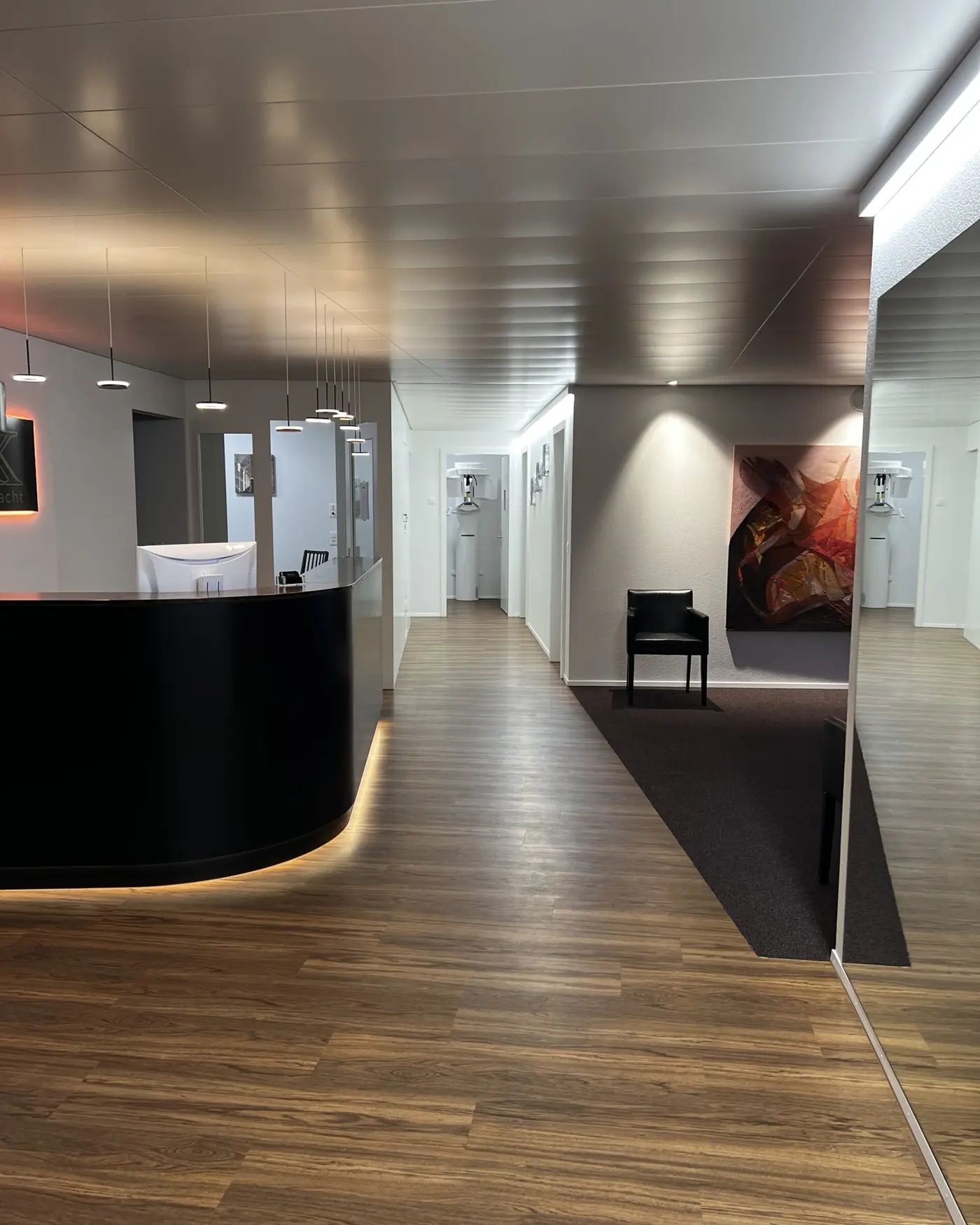
Allow plenty of time, but do not arrive too early, because waiting often makes people restless. Parking is available. If the person uses a wheelchair, tell us in your request. For more, see directions, parking and wheelchair access.
When the journey to the clinic is too much
If even the journey is too much, ask about a visit at home or in a care home. We check by phone first whether this is possible. A separate page describes how a dental home visit works.
Involving family members and carers
The companion is not always the representative
A daughter, a son, a care home nurse or someone from Spitex often comes along. But the companion does not automatically decide on treatment, as the next section shows. Please give us the contact details of the representative, the person entitled to decide.
What only family and carers know
Tell us how past dental visits went and what calms the person, such as a song or an object. The signs that tell you the person is uncomfortable matter too. Write down the key points for us.
What we may tell family members
We are bound by professional confidentiality (Art. 321 of the Swiss Criminal Code, StGB). The representative is informed about the planned treatment, as Art. 377 of the Swiss Civil Code (ZGB) requires. Other relatives only receive information with consent.
Who consents to dental treatment when a person lacks capacity
This is general information on Swiss law, not legal advice.
Capacity of judgement applies to a specific decision
Under Art. 16 ZGB, a person is capable of judgement if they can act rationally. A dementia diagnosis alone does not mean someone lacks this capacity. Each decision is assessed separately. Someone may still be able to consent to a check-up but not to a larger procedure.
The treatment plan under Art. 377 ZGB
If no patient decree covers the treatment, it is planned with the representative. The representative is told the reasons, type, risks and costs, the consequences of not treating and the alternatives. They decide according to the presumed wishes and interests of the person with dementia. That person is involved as far as possible, and the plan is adjusted as things change.
The order of representation under Art. 378 ZGB
Only the highest level at which someone meets the conditions is entitled to represent. If several people are entitled there, the treatment team may assume in good faith that they agree. The levels in order:
- the person named in a patient decree or an advance care directive
- a deputy with a right to act as representative in relation to medical procedures
- a spouse or registered partner who lives in the same household or regularly and personally provides support
- a person who lives in the same household and regularly and personally provides support
- children and other descendants who regularly and personally provide support
- parents, on the same condition
- siblings, on the same condition
Urgent cases under Art. 379 ZGB
Sometimes there is no time to ask the representative. Treatment then follows the person's presumed wishes and interests. A separate page explains what helps with acute toothache.
When the adult protection authority KESB steps in (Art. 381 ZGB)
If no one is entitled or willing to act, the child and adult protection authority (KESB) appoints a deputy as representative. It also steps in if it is unclear who the representative is, if those entitled disagree or if the person's interests are at risk. It acts on request or on its own initiative. Art. 380 ZGB only concerns the treatment of mental disorders in a psychiatric hospital.
Oral care with dementia and in older age
Why oral hygiene becomes harder with dementia
As dementia progresses, even habits such as brushing teeth are forgotten. According to a University of Zurich study, people with dementia see a dentist less often and have tooth decay more often. The Swiss dental association SSO also links mouth infections with pneumonia, cardiovascular disease and diabetes.
Daily mouth care tips for family and carers
These tips come from specialist organisations:
- keep to the usual time and place
- show rather than explain
- guide the toothbrush to the mouth; the person often then brushes unaided
- help from the side or behind, not the front
- use a toothbrush with a thick handle
- clean dentures daily and have them labelled with the person's name
- keep denture cleaning liquid out of reach
Check-ups and dental hygiene at the clinic
University of Zurich experts advise involving a dentist from diagnosis onwards. Larger treatments can then be planned while they are still possible. Separate pages cover what a routine dental check-up includes and how dental hygiene works, including ultrasound and AirFlow.
Contact for families, care homes and Spitex
For families caring at home
Call us on +41 44 915 17 77. To write to us, use the form to request an appointment. Tick “I am asking on behalf of another person” there. Under “Your request”, state your relationship to the person, for example daughter or nurse.
Dentist for care home residents with dementia
Nursing managers, named nurses and Spitex can contact us directly. Beforehand, please clarify who represents the person, what medication they take and who will come along. We discuss any cooperation with the nursing manager by phone. Organisational matters can also go to klinik@zk-k.ch. Please do not send health data by ordinary email.
The phone is not staffed during all opening hours. If no one answers, please try again later.
Frequently asked questions about dental care for dementia patients
Is your question not listed? Call us or send us an email.
+41 44 915 17 77Where can I find a dentist for dementia or Alzheimer's patients near Küsnacht?
Zahnklinik Küsnacht is at Goldbacherstrasse 3a, right next to Küsnacht Goldbach station, and is wheelchair accessible. If the person can no longer come to the clinic, ask us about a home visit.
Do dementia patients get free dental treatment in Switzerland?
Generally not: compulsory basic health insurance (Grundversicherung) does not usually pay for dental treatment. We bill transparently under the Dentotar tariff, with our tax point value (Taxpunktwert) of CHF 1.13. People on supplementary benefits (Ergänzungsleistungen) to old-age and survivors' insurance (AHV) or disability insurance (IV) can be reimbursed for simple, economical and appropriate treatment. For larger treatment, the municipality of residence or SVA Zürich, the cantonal social insurance institution, requires a cost estimate first.
Can a person with dementia refuse dental treatment?
Anyone capable of judgement for this decision may refuse, even with dementia. Otherwise, their representative decides. However, treatment against clear resistance counts as coercion. Swiss medical ethics guidelines allow coercion only as a last resort.
Does a person with dementia need a general anaesthetic for dental treatment?
Not always. Check-ups and smaller treatments can often be done while the person is awake. Otherwise, sedation or a general anaesthetic may be needed, for example in hospital. Their representative decides with the specialists.
How often should a person with dementia see a dentist?
There is no single interval that suits everyone. We set it after the examination. If the person suddenly eats less, an earlier appointment makes sense.
Can I request a dental appointment for my mother or father with dementia?
Yes, by phone or using the appointment form. If your parent can no longer decide for themselves, their representative must consent. That person is not automatically you.
What helps if a person with dementia refuses to brush their teeth?
A different time, place or person often helps. If brushing is not possible at all, rinsing with water after meals is better than nothing.
Related pages
- Dental home visits explained
A visit at home or in a care home.
- Check-ups and prevention at a glance
What happens at a check-up.
- Dental hygiene appointments and costs
How teeth cleaning works.
Request an appointment for a person with dementia
It is easiest to sort out by phone who represents the person, which time of day suits and who comes along.